Map size in jpg-format: 24.874MiB
Click to open in high resolution (open in new tab).

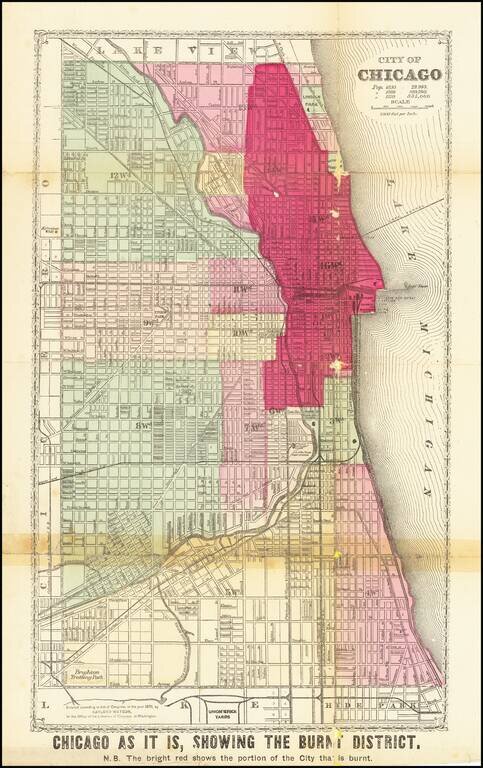
Detailed Plan of Chicago Showing the Area Ravaged by the Great Chicago Fire
Scarce map showing the area affected by the Chicago Fire of 1871, with the "Burnt District" colored in red.
The map has each street labeled, along with the rivers flowing through the city and each ward. Lake Michigan is labeled to the east of Chicago, with Hyde Park and the stockyards to the south, and Lake View to the north. On the top right of the plan is a simple title cartouche which includes the growth of the city’s population over time, and under that, a scale bar.
This map was not primarily meant to show the street grid, however, but to show the portion of the city harmed by the Great Chicago Fire.
The Great Chicago Fire
The Great Chicago Fire was a conflagration that burned October 8–10, 1871. While no one knows the exact cause of the fire, it started in a barn belonging to the O’Leary family, with their barn the first building to catch fire.
Since most buildings in Chicago were made from wood with tar or shingle roofing, the fire had plenty of fuel to keep it going. Additionally, Chicago was experiencing a drought, causing the entire city to be extremely dry. The fire only worsened due to a mistake by the fire watchmen which sent the firefighters to the wrong part of the city, significantly delaying the effort to fight the fire.
Firefighters hoped that the South Branch of the Chicago River would act as a boundary for the fire. However, a plethora of lumber and coal yards along the river caught fire. Strong gusts of wind blew burning debris from one side of the river to another, again catching the firefighters off guard. The fire began to spread uncontrollably when the superheated flames met with cooler air above the city, causing many tornado-like whirling masses of fire to appear throughout the city.
After two days of burning, the fire began to run out of fuel. On October 9th it rained, with the fire only continuing in lightly populated areas outside the city.
After the fire
After the fire had burnt itself out and eventually succumbed to rain, 300 people lay dead, 100,000 residents were homeless, and 4.593 billion dollars in damages was done (as adjusted for 2019). To prevent further chaos from gripping the city, General P. H. Sheridan placed the city under martial law for two weeks.
In the coming weeks, money and aid arrived from around the world to help relieve the population of Chicago. The city successfully rebuilt and implemented stringent fire regulations to prevent devastating fires from raging again. Just over twenty years later, Chicago was a thriving city and they hosted the 1893 Columbian Exposition.
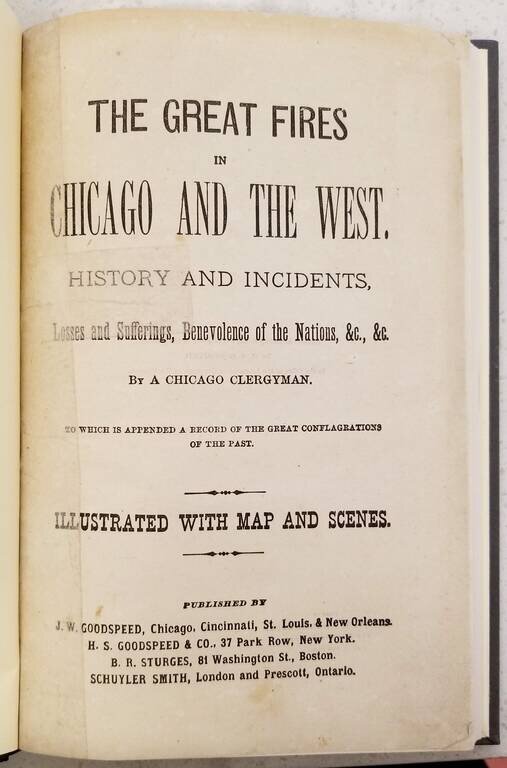
This map was published in Chicago, just after the fire occurred, by Gaylord Watson. A scare historical artifact, it shows those from outside the city the sheer scale of destruction caused by the fire.
The Great Chicago Fire
The Great Chicago Fire was a conflagration that burned in the American city of Chicago on October 8–10, 1871. The fire killed approximately 300 people, destroyed roughly 3.3 square miles (9 km2) of the city, and left more than 100,000 residents homeless.
If you are a student, write to us in telegram: @antiquemaps and indicate what material you need and for what work you need a map in high detail. We are ready to provide material on special terms. For students only!