Map size in jpg-format: 44.8221MiB
Click to open in high resolution (open in new tab).
Rare Eclipse Broadside by Thomas Wright and Published by John Senex, the Foremost Producer of Astronomical Broadsides in the Eighteenth Century
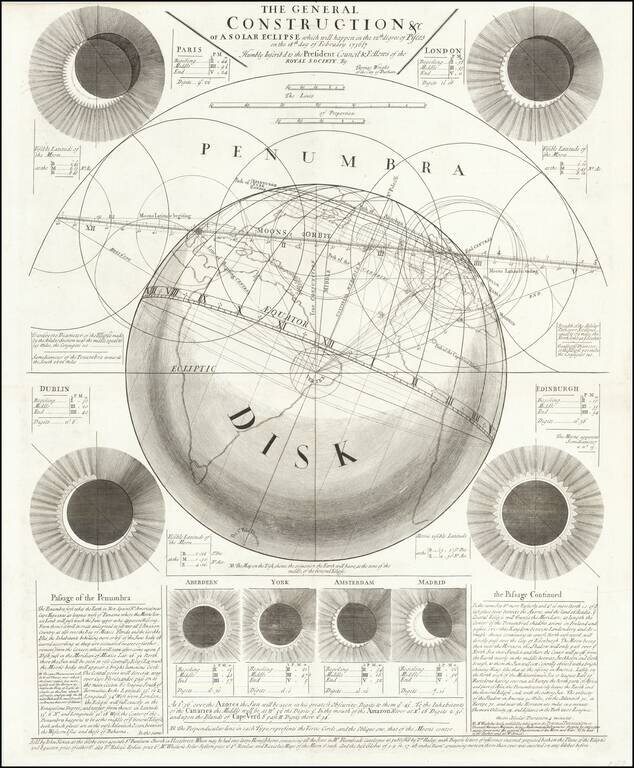
Fine, large broadside illustrating a prediction of the path of the solar eclipse of February 18, 1737. It was created by the astronomer Thomas Wright and published by John Senex for the Royal Astronomical Society.
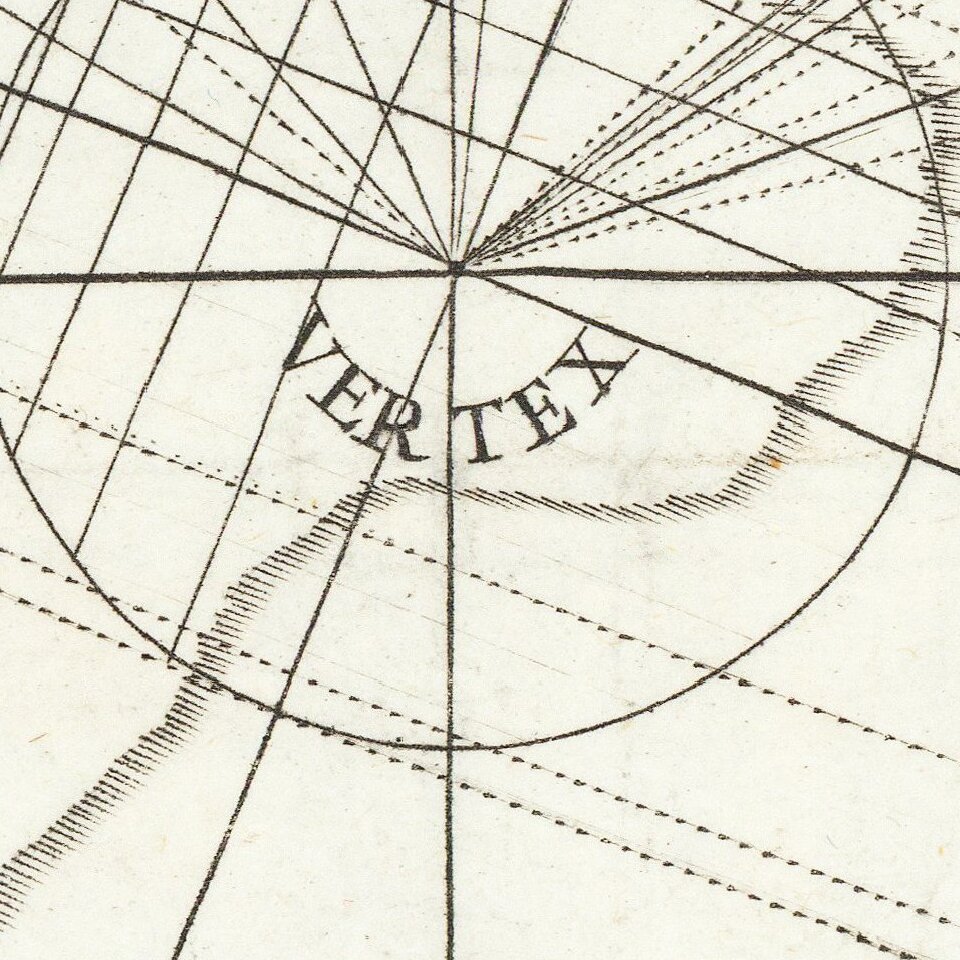
The broadside illustrates and explains the path of the coming eclipse with the moon’s path and its variations shown on a hemispheric map. Diagrams surrounding the central chart show the appearance of the eclipse at its utmost and the timing of the beginning, middle and end of the eclipse to residents of Paris, London, Dublin, Edinburgh, Aberdeen, York, Amsterdam and Madrid.
The image was created at the tail end of Senex's career as a mapmaker and publisher of astronomical materials. The present example is one of his largest and most elaborate astronomical broadsides, as well as one of his rarest works.
The solar eclipse of March 1, 1737 (corrected to February 18, as Britain did not adopt the Gregorian calendar until 1752) was an annular solar eclipse, meaning that at the center of the moon’s shadow’s path across the earth, the shadow almost completely covers the sun. The path of the annular passed directly over Scotland, but it was visible as a partial solar eclipse in much of Europe. However, Wright here suggests that the eclipse will be total over Edinburgh.
Astronomy, eclipses, and astronomical broadsides in eighteenth-century Britain
The movement of the sun, moon, and stars (and eventually of the earth itself) has long fascinated humans, dating from ancient times. Astronomy is also a useful subject with practical applications, including in navigation, cartography, and timekeeping.
In England, the utility to navigation was of the utmost importance in the seventeenth century. In the interest of furthering imperial claims and maritime commerce, King Charles II (r. 1661-1685) ordered the creation of a Royal Commission to investigate investment in astronomy. The Commission eventually recommended the creation of an observatory to be headed by an “astronomical observer”. They, at the suggestion of architect and astronomer Christopher Wren, chose Greenwich as the site of the observatory—Britain’s first state-funded scientific institution—and named John Flamsteed as the first Astronomer Royal.
Flamsteed is well known for plotting the visible stars in the northern and southern hemispheres, a project shared with the second Astronomer Royal, Edmond Halley. He also derived lunar tables, which helped in the prediction of the dates and times of future eclipses, one of the most popular and culturally salient astronomical events.
A lunar eclipse occurs when the earth passes between the sun and the moon, blocking the sun’s light while the moon is in the earth’s shadow. A rarer phenomenon, a solar eclipse occurs when the moon passes between the earth and the sun; this can totally block the sun’s light (total eclipse), nearly totally block the sun (annular eclipse), or partially block the sun (partial eclipse), depending on one’s location on earth and the path of the shadow cast on the earth by the moon.
For many centuries and across many cultures, eclipses have been interpreted as significant events with serious consequences. For the Ancient Greeks, for example, eclipses were thought to be bad omens, signs of an angry god. In eighteenth-century Britain, they were understood as both scientific phenomena to be studied, as well as possible warnings to be heeded. A newspaper in 1748, citing an upcoming solar eclipse, linked the solar eclipse of 1715 to the rebellion at Preston, while a 1745 solar eclipse supposedly foretold the Jacobite rising.
Others saw eclipses as an economic opportunity. As literacy rates rose in the eighteenth century, and as the intellectual waves of the Enlightenment spread more broadly, more and more people clambered to not only view, but also understand, eclipses. In previous centuries, astrological broadsides had advertised doom and gloom when a comet or eclipse was predicted. Cartographic publishers such as John Senex updated this genre by selling astronomical broadsides that included explanations of what eclipses were, how the solar system worked, and how to view an eclipse.
Senex published at least twelve such broadsides during his career. Of these, nine focused on eclipses of the sun or moon, two on general astronomical information, and one on the transits of Venus and Mercury. Four were written by William Whiston, four by Edmond Halley, and two by Thomas Wright. Senex used the prints to advertise his other wares; the broadsides sold for 6 pence to 2 shillings 6 pence, making them available to a wide swath of the reading public. Additionally, there were ephemeral objects, making them rare on the market and in institutional collections today.
Rarity
The broadside is very rare. OCLC and Armitage locate a single example at Durham University Library, which was almost certainly the copy owned by Thomas Wright, who was born and lived his later life in County Durham.
If you are a student, write to us in telegram: @antiquemaps and indicate what material you need and for what work you need a map in high detail. We are ready to provide material on special terms. For students only!