Map size in jpg-format: 15.6637MiB
Click to open in high resolution (open in new tab).
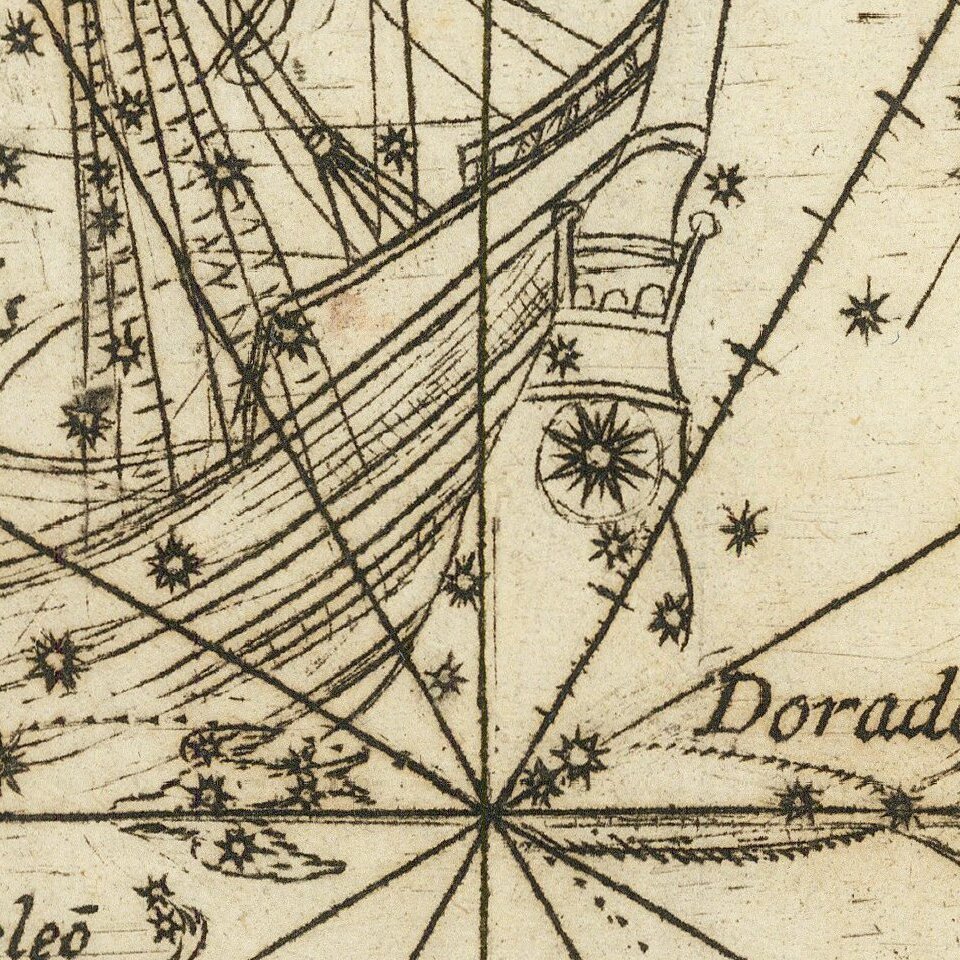
Cassini's Mapping of the Comet of 1664-65
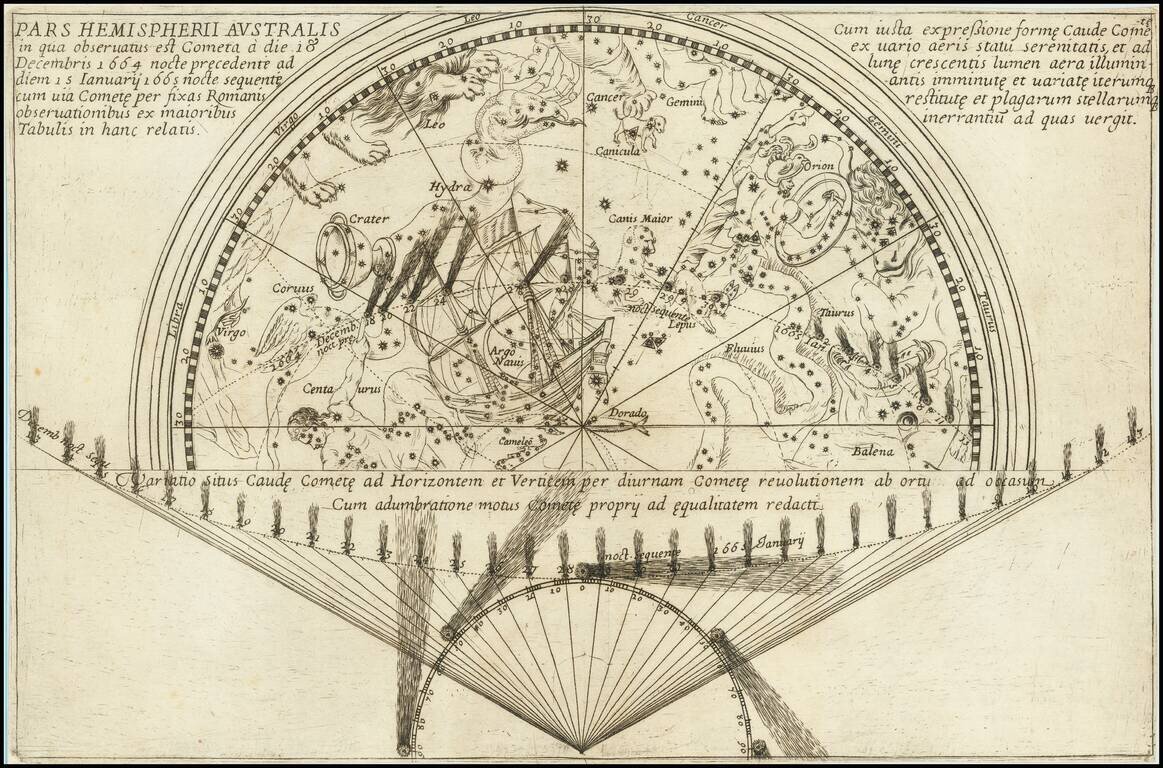
Finely engraved image of the comet which passed through the European skies between December 18, 1664 and January 15, 1665, which appeared Giovanni Domenico Cassini's rare Theoria Motus Cometae Anni MDCLXIV . . .
The map is centered on Argo Navis, Canis Major, Hydra and Orion, with an arc tracking the transit of the comet across the main map from left to right beginning on December 18, 1664 and ending January 15, 1665. At the bottom center is a circular model, illustrating Cassini's theory on the orbit of the comet, which was at the time quite advanced for its time.
Cassini's observations of the comet led to his formulation of a new theory (in agreement with the Tychonian system) in which the orbit of the comet is a great circle whose center is situated in the direction of Sirius and whose perigee is beyond the orbit of Saturn. Cassini's detailed observations of the comet were made with a powerful new telescope constructed by Roman lensmakers Giuseppe Campani and Eustachio Divini. Beginning in 1664, Cassini was able to obtain powerful celestial telescopes of great focal length.
The large engraved plate depicts the course of the comet in the southern celestial hemisphere from December 13 1664 through the middle of January of 1665. It also shows the appearance and direction of the comet';s tail in a series of nightly dated observations. The great comet of 1664-5 was observed my many astronomers, including Newton, Auzout, Borelli, Fabri, Hooke, Hevelius, Huygens, Hooke Montanari and Petit.
Rarity
Cassini's Theoria Motus Cometae Anni MDCLXIV . . . is very rare on the market. This individual plate is even rarer in commerce.
If you are a student, write to us in telegram: @antiquemaps and indicate what material you need and for what work you need a map in high detail. We are ready to provide material on special terms. For students only!