Map size in jpg-format: 21.6018MiB
Click to open in high resolution (open in new tab).
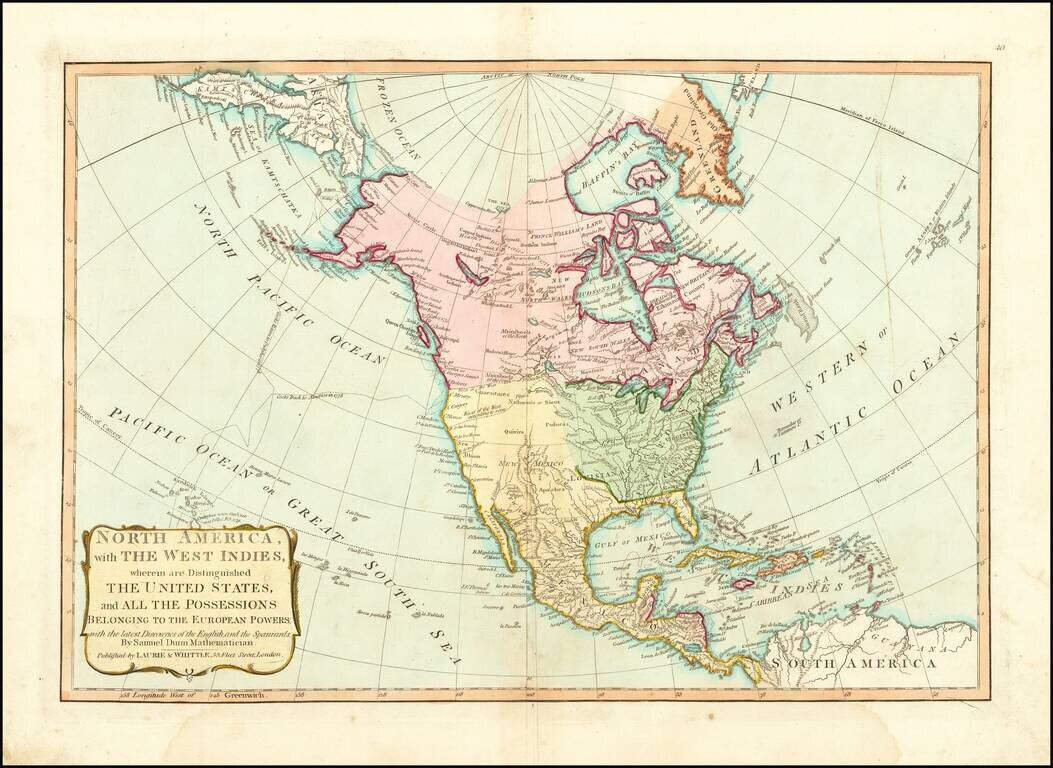
Striking example Samuel Dunn's map of North America.
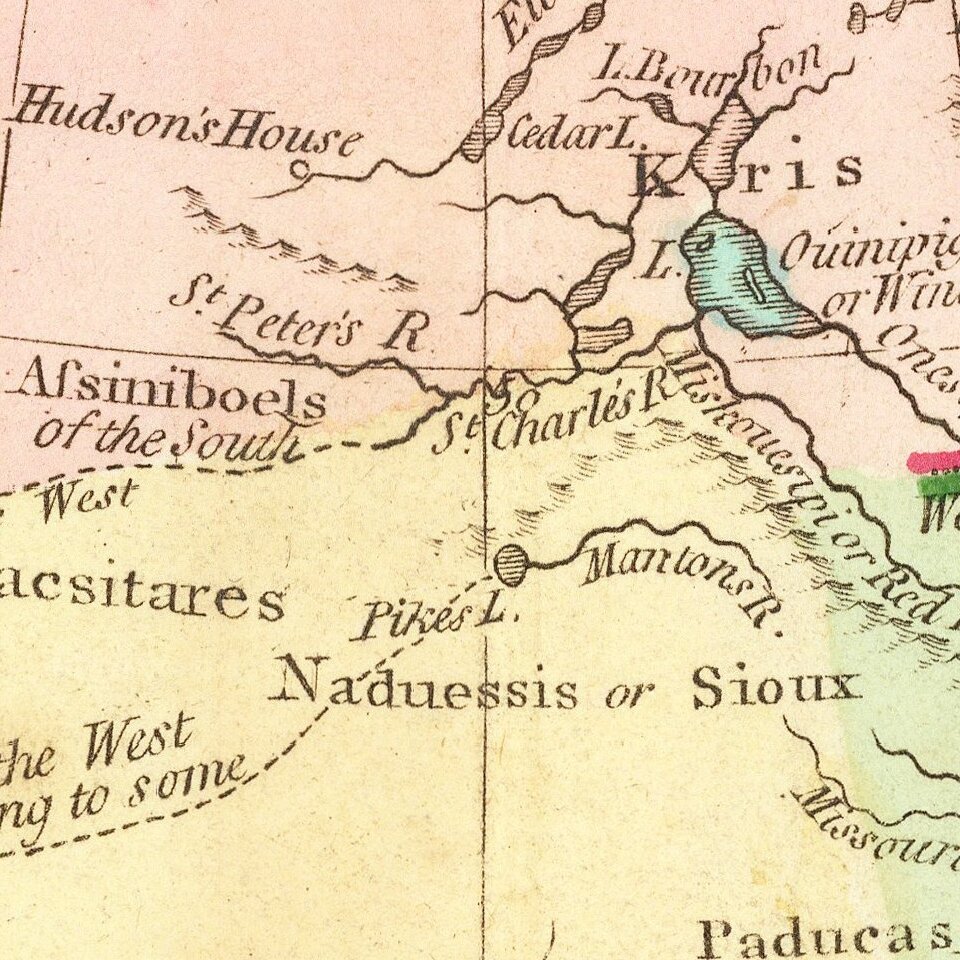
The map provides an interesting depiction of North America, shortly after the close of the American Revolution. The US is colored in Green. To the west, the vast unknown regions of Louisiana, New Mexico, Quivira and Albion are shown, including the "The River of the West according to some," with a second tentative "River of the West" shown to the north, one of the few English maps to show 2 such rivers.
Along the Northwest Coast of America, the discoveries of Captain James Cook in 1775 and 1778 are shown, along with Hearn's discoveries near the Canadian Arctic Circle. A single Hudson's Bay Company House is located.
Samuel Dunn (bap. 1723-1794) was a teacher of mathematics and navigation who published, among other things, maps and charts. Although information about his early education is lacking, by age nineteen he was leading his own school and teaching writing, accounting, navigation, and mathematics in Devon. In 1751, he moved to London, where he taught in several schools and tutored privately.
By the 1760s, Dunn was known as a respected astronomer and had published a range of textbooks on math, navigation, and astronomy. After the publication of the Nautical Almanac, Dunn acted as a certifier of ships’ masters under the new system, on behalf of the Board of Longitude. He performed similar work for the East India Company, as well as made charts of the East Indies. In 1776 he published A New Variation Atlas and, in 1777, A New Epitome of Practical Navigation, or, Guide to the Indian Seas. By 1780, he was named editor of the New Directory for the East Indies, which included his own charts. In 1786, he released a pioneering study, Theory and Practice of Longitude at Sea. He also designed several instruments for navigation.
Dunn died at his home in Fleet Street in January 1794. His books and maps were auctioned at Sothebys in a sale of over 1,000 lots. Many of these were bought by Alexander Dalrymple, hydrographer of the East India Company and soon-to-be-named first head of the Hydrography Office.
If you are a student, write to us in telegram: @antiquemaps and indicate what material you need and for what work you need a map in high detail. We are ready to provide material on special terms. For students only!

![[Signed Political Satire Artwork] Vietnam ... Vietnam ... Vietnam ...](/map/small/68726.jpg)
