Map size in jpg-format: 51.6448MiB
Click to open in high resolution (open in new tab).
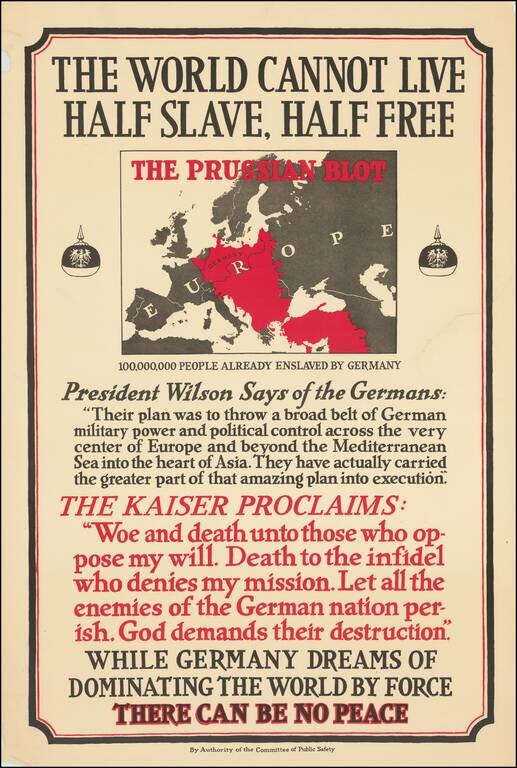
This is a great American propaganda poster encouraging US involvement in World War I. The work attempts to reshape the way that Americans viewed the war by rephrasing the conflict as a result of German imperial ambitions. The map is particularly interesting as both Austria-Hungary and the Ottoman empire are portrayed as under Prussian subjugation, which is not the only time the work departs from the truth.
The work includes a map of Europe showing the land occupied by Germany in red, with the words: "The Prussian Blot. 100,000,000 People Already Enslaved by Germany." At the bottom it reads: "While Germany Dreams of Dominating the World By Force, There Can Be No Peace."
The text provides:
President Wilson says of the Germans: "Their plan was to throw a broad belt of German military power and political control across the very center of Europe and beyond the Mediterranean Sea into the heart of Asia. They have actually carried the greater part of that amazing plan into execution." The Kaiser proclaims: "Woe and death unto those who oppose my will. Death to the infidel who denies my mission. Let all the enemies of the German nation perish. God demands their destruction." While Germany Dreams of Dominating The World By Force There Can Be No PeaceThe Wilson quote comes from a speech he gave on Flag Day, June 14, 1917. The Kaiser quote, unsurprisingly, appears to be completely fabricated. The importance of the map to the work and the choice of coloring provide a particularly interesting study into the effectiveness of propaganda.
Propaganda Committees in America During the War
From the outbreak of World War I until America's declaration of war in April 1917, the official posture of the country had been neutrality. The public was far from unified behind the cause. There had been concerns from policy hawks as to whether German-Americans would fight against the Kaiser and whether Irish-Americans would be willing to fight alongside the British. Additionally, there were vocal misgivings as to involvement from intellectuals, labor leaders, progressive reformers, and long-time isolationists.
To meet these concerns, President Woodrow Wilson launched an all-out effort to gain wider public support. On April 15, he created the Committee on Public Information, headed by a former muckraking journalist, George Creel. The Committee conducted a "vast enterprise in salesmanship," in which it "extolled American greatness and condemned German barbarism by using sensational stories of atrocity, which were later discredited."
The Committee was "charged with the task of directing the release and suppression of government news to promote the absolute justice of America's cause, the absolute selflessness of America's aims.'" Other organizations helped in this effort. The Council of National Defense had been created in 1916 to coordinate mobilization efforts, and had created State Councils of Defense to assist it after the war began, "The state councils became primarily propaganda agencies to generate public support for the war effort."
The history of the Committee for Public Safety is less well understood, but was certainly associated with the Committee on Public Information to some extent. It seems that several states created these committees shortly before the war started and that they were more localized. Several of these were reincorporated from previous emergencies, for example, the Massachusetts Committee on Public Safety had been dissolved in 1775 and would not be reappointed until 1917.
If you are a student, write to us in telegram: @antiquemaps and indicate what material you need and for what work you need a map in high detail. We are ready to provide material on special terms. For students only!

![[Eastern Hemisphere Globe Gores] (Nova et integra universi Orbis descriptio)](/map/small/54480.jpg)
![[Signed Political Satire Artwork] Vietnam ... Vietnam ... Vietnam ...](/map/small/68726.jpg)