Map size in jpg-format: 16.0828MiB
Click to open in high resolution (open in new tab).
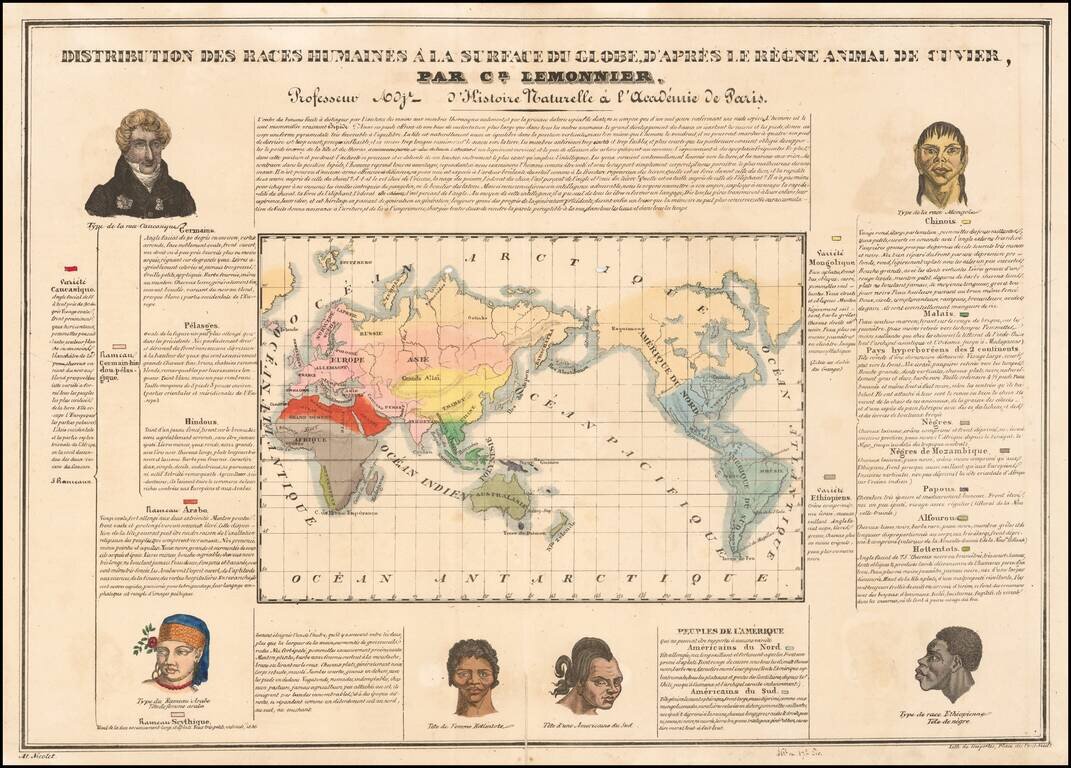
A Graphic Adaptation of George's Cuvier's Le Regne Animal To The Human Race
Rare Ethnographic Map of the World, illustrating the distribution of human races by Louis-Ceran Lemonnier, based upon the methods set forth in Georges Cuvier's Le Regne Animal, a highly influential work on the classification of Animals written at the beginning of the 19th century.
Professor Lemonnier was one of the early Cuvier scholars who wrote a later edition of Cuvier's work, which was also translated into English. In his Synopsis, he includes a chapter on the classification of the various branches/varieties of the Human Race. Lemonnier divides the world into various groups, then displays the various groups by color coding across the globe. Based upon physical observations, Professor Louis-Ceran Lemonnier divided humans into the following groups:
In 1837, Lemmonier also produced his Atlas de la géographie des trois règnes de la nature. Distribution des animaux, des végétaux, des minéraux, à le surface du globe, which contained 3 maps, showing the distribution of Animals, Vegetables and Minerals around the globe. He also produced his Tableau historique des révolutions du globe, par C. Lemonnier, an undated work also lithographed by Desportes in Paris.
Le Règne Animal
Le Règne Animal (The Animal Kingdom) is the most famous work of the French naturalist Georges Cuvier (1769-1832). It sets out to describe the natural structure of the whole of the animal kingdom based on comparative anatomy, and its natural history. Cuvier divided the animals into four branches (roughly corresponding to phyla), namely vertebrates, molluscs, articulated animals (arthropods and annelids), and zoophytes (cnidaria and other phyla).
The work appeared in four octavo volumes in 1817; a second edition in five volumes was brought out in 1829-1830 and a third, written by twelve "disciples" of Cuvier, in 1836-1849. In this classic work, Cuvier presented the results of his life's research into the structure of living and fossil animals. With the exception of the section on insects, in which he was assisted by his friend Pierre André Latreille, the whole of the work was his own. It was translated into English many times, often with substantial notes and supplementary material updating the book in accordance with the expansion of knowledge. It was also translated into German, Italian and other languages, and abridged in versions for children.
Le Règne Animal was influential in being widely read, and in presenting accurate descriptions of groups of related animals, such as the living elephants and the extinct mammoths, providing convincing evidence for evolutionary change to readers including Charles Darwin, although Cuvier himself rejected the possibility of evolution.
Rarity
The present work is unrecorded. The BnF apparently holds a work with the same title, with the imprint of Trinquart.
If you are a student, write to us in telegram: @antiquemaps and indicate what material you need and for what work you need a map in high detail. We are ready to provide material on special terms. For students only!