Map size in jpg-format: 7.22439MiB
Click to open in high resolution (open in new tab).
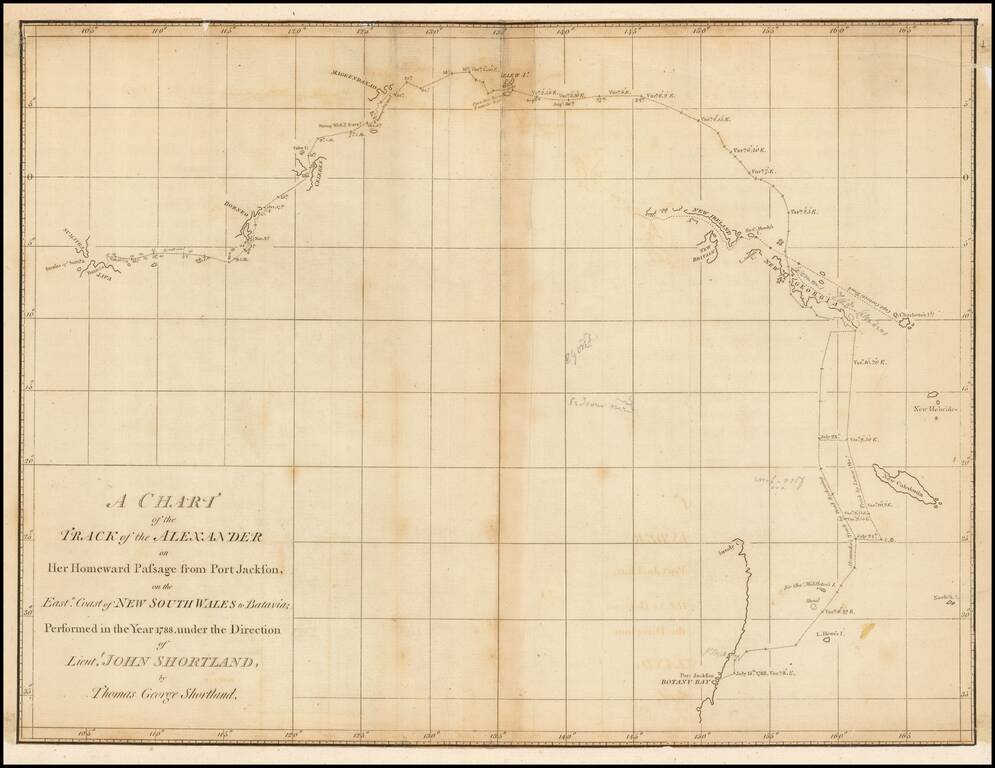
The Return of the First Fleet -- Fundamental Map for Australian Collectors
A highly important map in the history of settling Australia, with the present example including annotations in pencil noting a ship wreck and other details.
The track of the Alexander shows the first leg of the homeward journey back to England as far as Java. While the lower southeastern coast of Australia is depicted, the rest of the continent is left out for no apparent reason. The chart by Lieutenant Shortland is an important part of Australia's first settlement history. It originally appeared in Arthur Phillips 'A Voyage to Botany Bay…' in which he outlined the extent and accounts of the new settlement in Sydney.
John Shortland was appointed naval agent to the transports of the First Fleet. It was his responsibility to ensure that the contracts for transport were fulfilled as planned. After remaining at Port Jackson until July 14, he sailed for England in the Alexander, carrying the first dispatches of Governor Phillip to the secretary of state. The Alexander was accompanied on the return trip by the Borrowdale, Prince of Wales and Friendship.
The Alexander was one of the eleven ships that made up the first fleet, which settled the English in Australia in January 1788. The 450- ton convict transport ship transported around 200 convicts to the new settlement in Australia.
On the home voyage Shortland discovered and charted many islands and reefs, including the dangerous Middleton Shoal and sighted the Solomon Islands.
Pencil Annotations
Along the route, the following annotations appear:
Wreck Reef is almost certainly a reference to Wreck Reefs.
In 1803, when Matthew Flinders left Port Jackson for the last time in HMS Porpoise, in company with Cato and Bridgewater, he sailed by the Outer Route to Torres Strait. Wreck Reef, or rather the chain of reefs on which Porpoise and Cato were wrecked on the morning of August 17, 1803, on the eastern side of the barrier and about eighteen and a half miles in length and from a quarter to a mile and a half in breadth. It consists of patches of coral reef separated by navigable channels.. The eastern end of it, named, Flinders said, "not improperly," Bird Islet, was found to be covered with coarse grass and shrubs. After striking, "Porpoise took a fearful heel over on her larboard beam ends," fortunately falling towards the reef so that her people were saved. Cato, under Captain Park, struck about two cables length away and "fell on her broadside," when her masts instantly disappeared. Several of the seamen were bruised against the coral rocks and three young lads drowned. One of the poor boys who had been shipwrecked no less than three or four times before—in every voyage that he had made—clung to a spar beside his captain and through the night bewailed that he "was the persecuted Jonas who carried misfortune wherever he went." He lost his hold among the breakers, was swept away, and seen no more.
If you are a student, write to us in telegram: @antiquemaps and indicate what material you need and for what work you need a map in high detail. We are ready to provide material on special terms. For students only!

![Cuba Insula [with] Hispaniola Insula [with] Insula Jamaica [with] Ins. S. Ioannis [with] I.S. Margareta Cum Confiniis](/map/small/70194.jpg)