Map size in jpg-format: 95.274MiB
Click to open in high resolution (open in new tab).
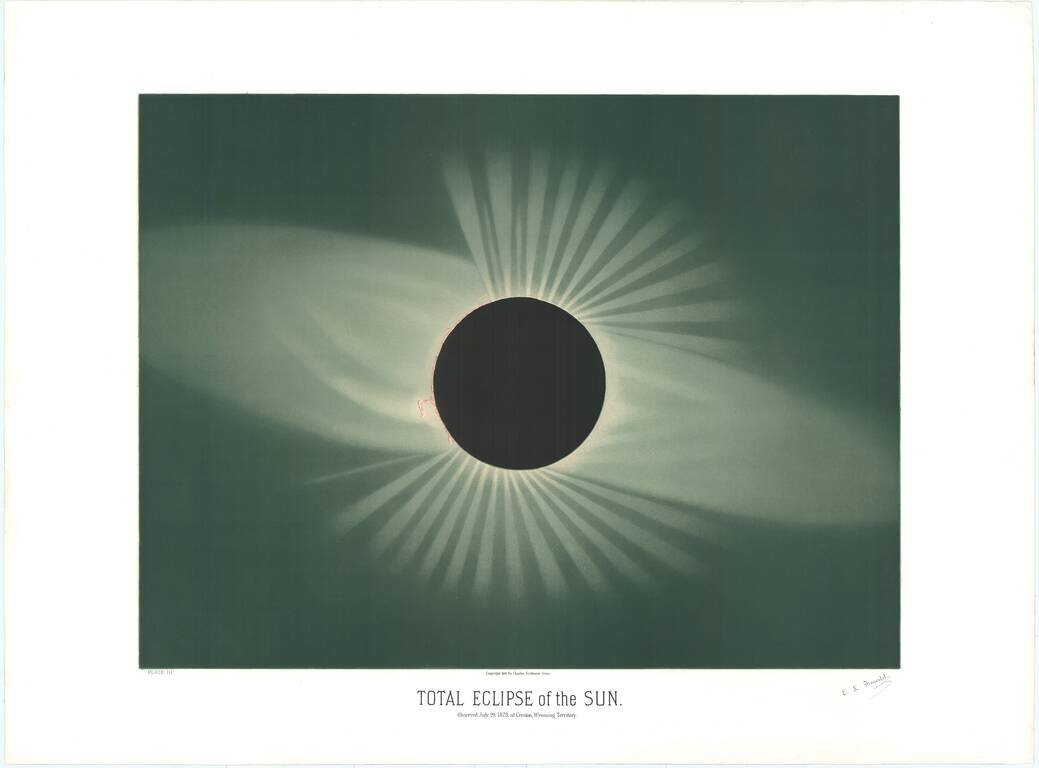
A Magnificent Depiction of a Total Solar Eclipse. Made by the "Audubon of the Sky", Etienne Trouvelot.
This is a beautiful color lithograph showing an eclipse of the sun, made by Etienne Trouvelot and relating his observations made during the summer of 1878 in the Wyoming Territory. The chromolithograph was published as part of Trouvelot's Astronomical Drawings set of 15 plates by Charles Scribner's Sons in 1882.
Trouvelot's drawings are known as some of the best images of the sky ever made. Trouvelot's work was very important at the time, as it provided important images of the stars, planets, and phenomena of the sky at a time when popular interest in astronomy was growing, but photography had not yet become advanced enough to capture such dark images. Trouvelot's images are recognized as the last of the great images of the night sky that surpassed the photography of their day.
"Terrifying, appalling, and yet possess[ing] a majestic grandeur and fascination" -- the 1878 Solar Eclipse
The 1878 eclipse fascinated the American public and drew observers from all over the country, much like the 2017 eclipse which passed through the same region. Enthusiasts like Thomas Edison arrived to test out new devices, while astronomers prepared diligently for over a week to make sure that they would not miss the event. The U.S. Naval Observatory even set up a field observatory, complete with roof.
Solar eclipses have always captivated humanity due to the epic nature of their occurrence. By the 18th century, they were studied regularly, and in Trouvelot's time, they were fairly well understood. Particularly important is that, during an eclipse, certain features of the sun become more easily visible. In this image, we see both the corona (the white rays), which is the sun's atmosphere, and solar prominences (the red light to the right), which are jets and loops of plasma hundreds of thousands of miles long.
Trouvelot provides a useful description of the phenomena shown as follows in his Trouvelot Astronomical Drawings Manual:
A telescopic view of the sun’s corona or extreme outer atmosphere and of the solar flames or prominences during a total eclipse. At the moment of observation the dark disk of the moon, while still hiding the sun’s main body, had passed far enough eastward to allow the rosy pink chromospheric prominences to be seen on its western border. On all sides of the sun’s hidden disk, the corona shows its pale greenish light extending in halo-like rays and streamers, and two very remarkable wings stretch eastward and westward very nearly in the plane of the ecliptic and in the direction of the positions of Mercury and Venus respectively at the time of observation. The full extent of these wings could not be shown in the Plate without reducing its scale materially, since the westerly wing extended no less than twelve times the sun’s diameter, and the easterly wing nearly as far, or over ten million miles. A circlet of bright light immediately bordering the moon’s disk is the so-called inner corona, next to which the wings and streamers are brightest, thence shading off imperceptibly into the twilight sky of the eclipse. Other noteworthy peculiarities of the corona, as observed during this ellipse, are the varying angles at which the radiating streamers are seen to project, the comparatively dark intervals between them, and the curved, wisp-like projections seen upon the wings. An especially noticeable gap appears where the most westerly of the upward streamers abruptly cuts off the view of the long wing. The largest and brightest of the curving streamers on the westerly wing coincides with the highest flame-like protuberance. To some observers of this eclipse the upward and downward streamers seemed pointed at their outer extremities and less regular in form.
Rarity
Trouvelot's prints were originally intended for the astronomical and scientific community and most of the larger US observatories purchased copies of the portfolio. In 2002, B.G. Corbin undertook a census to determine the number of surviving copies of the complete set of 15 prints and was only able to confirm the existence of 4 complete sets.
If you are a student, write to us in telegram: @antiquemaps and indicate what material you need and for what work you need a map in high detail. We are ready to provide material on special terms. For students only!