Map size in jpg-format: 2.45421MiB
Click to open in high resolution (open in new tab).
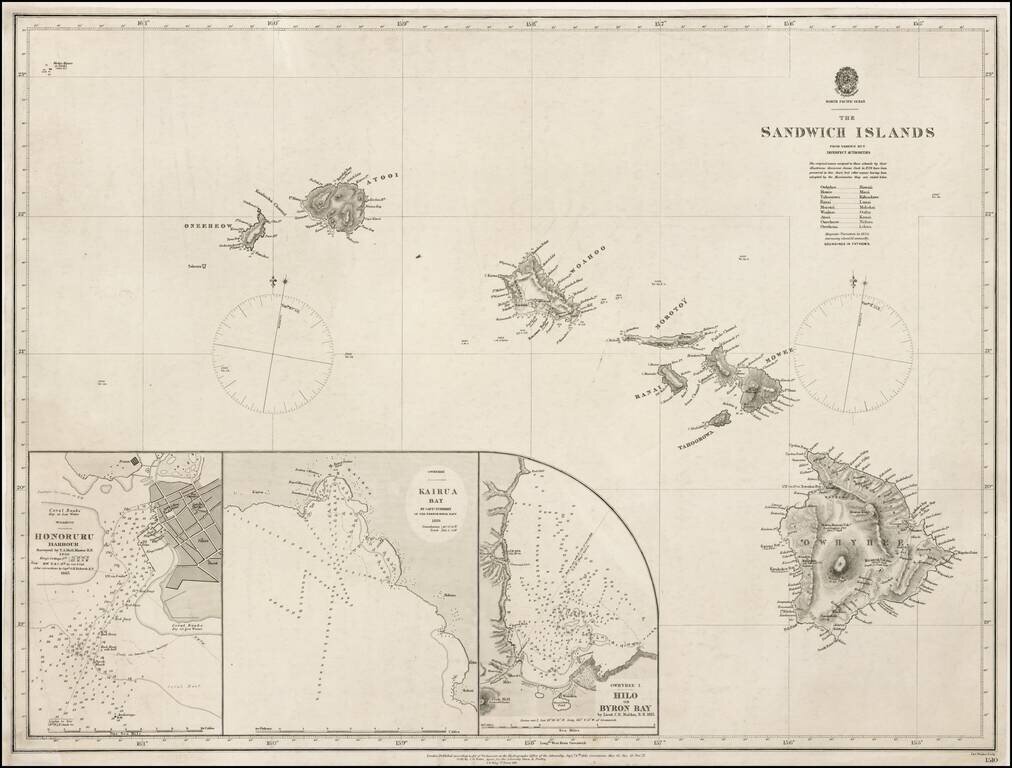
Highly Detailed and Scarce Admiralty Chart of Hawaii
Fine, thorough chart of Hawaii first published in 1843 and revised to 1871. The present chart includes inset maps of "Hilo or Byron Bay" by C.R. Malden in 1825. It also includes Kairua Bay (Kailua), based upon the surveys of Duperrey in 1819, and Honoruru Harbor (Honolulu), based upon the surveys of T.A. Hull in 1856, with corrections by G.H. Richards to 1863. The chart is a visual history of the surveys of the islands and is a good example of the system of updating used by the British Admiralty's Hydrographic Office.
The first Britons to publish an encounter with Hawaii were James Cook and his crew on his third voyage. Intended to locate the elusive Northwest Passage, Cook and his men stopped at what he called the Sandwich Islands twice. On the second visit cost Cook his life, but his ship and crew sailed home and his edited journal was published in 1784. It included 87 plates showing maps and illustrations. One of these was the first printed map of Hawaii, taken from manuscript sketches by Cook, Lieutenant Henry Roberts, and perhaps William Bligh, a master on the voyage, from 1778 and 1779. Cook's original recorded place names are compared to the revised names given by missionaries in a table below the title.
Other explorers also charted Hawaii, including the Frenchman La Perouse in 1786 and George Dixon and Nathaniel Portlock, veterans of Cook's third voyage, also in 1786. Spurred by the fur trade that was also brought to European attention by Cook, Americans, the Spanish, and Russians soon joined the French and British in frequenting, and charting, Hawaii.
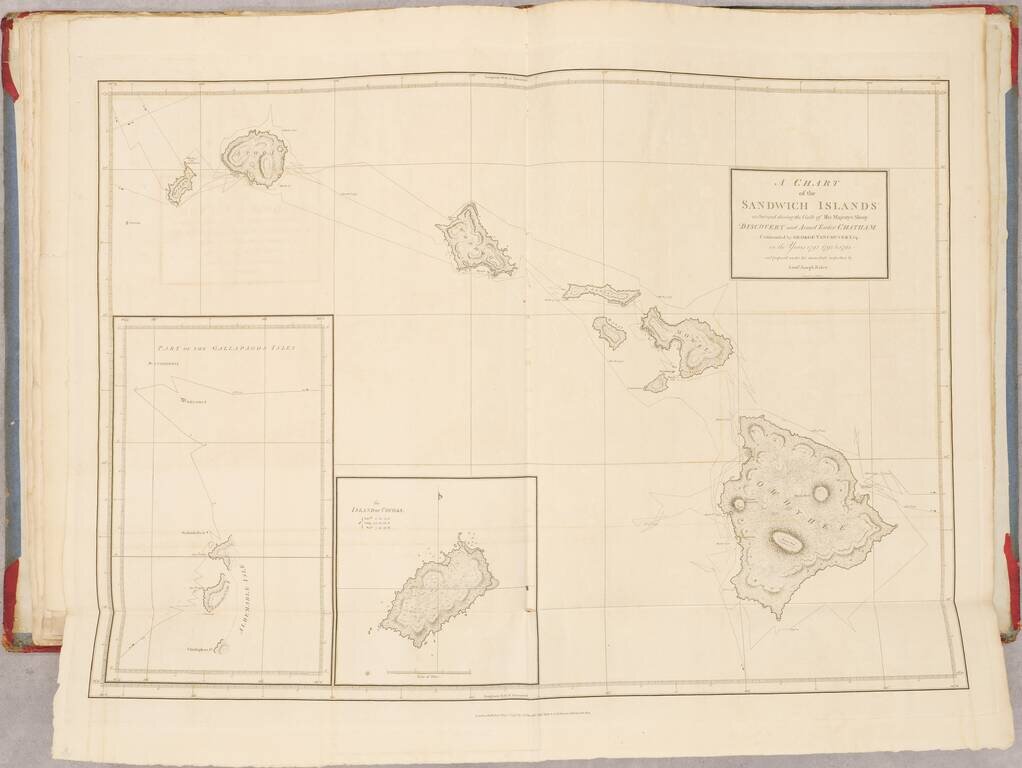
According to Fitzgerald, the honor of the "first complete map" of Hawaii goes to George Vancouver, who served as midshipman on Cook's second and third expeditions (39). Vancouver visited Hawaii several times from 1792 to 1794. The resulting A Chart of the Sandwich Islands is credited to Vancouver's lieutenant, Joseph Baker, but more likely was the result of the measurements and observations of several officers.
By the time Vancouver's voyage had been published, in 1798, the British Admiralty had decided to centralize their chart collection and production and founded the Hydrography Office in 1795. It was put in the hands of Alexander Dalrymple, who was the Royal Society's first choice for the Transit of Venus expedition that was eventually to be commanded by Cook as his first Pacific voyage. All Vancouver's charts passed into the HO's holdings, which explains why the Baker chart was the basis for subsequent Admiralty charts of the Sandwich Islands, including this one.
Baker's influence is clear on this map, but so are contributions by Russian navigators and a Frenchman, Duperry. Louis Isidore Duperrey was a part of the French scientific voyage commanded by Louis de Freycinet (1817-1820). During the voyage, Duperry surveyed the harbors of Honolulu, Kailua, Kawaihae, and Lahaina. His chart of Kailua (Kairua is used on the chart) is included as an inset, which is interesting, since it originally recorded the latitude of the bay wrongly. Here, however, a new latitude for a local landmark have been inserted.
The inset of "Hilo or Byron Bay" was surveyed by Lieutenant Charles Robert Malden. Malden was serving on an unusual voyage; its objective was to return the bodies of King Liholiho and his wife, Kamamalu, to Hawaii. The couple had been on the first overseas visit by Hawaiian royalty, but they caught the measles and died suddenly in London. Malden drew several maps, including the first plan of Kilauea crater, a plan of Honolulu, and a plan of Hilo Bay. The latter is used on this chart, as it was important at the time. Although not published until 1841, the plan of Hilo revealed a new, safe bay for ships that had previously been overlooked. The name Byron Bay comes from the commander of the expedition, Lord George Anson Byron.
The other inset, of Honolulu (Honoruru is used on the chart) is the result of the survey of T. A. Hull in 1856 and G. H. Richards in 1863, which reminds us that this chart is an 1871 update on the 1843 original. By the mid-nineteenth century, the Hydrography Office was frequently updating its charts with new information from the global voyages of Royal Naval ships. Thanks to their information network, they were able to make the most accurate maps in the world at that time. For example, on the original 1743 edition of this chart, Baker's original outline was improved with Malden's work for Southern O'ahu. There were still errors, but, as Fitzgerald explains, "Rather than being a sign of shoddy mapmaking, these errors emphasize the problems faced by the cartographers of the period" (140).
Thus, although this chart is supposedly drawn from "various but imperfect authorities," it actually represents the most authoritative chart of the Sandwich Islands available at that time. Additionally, it is a very scarce on the market and in institutions. OCLC locates no other examples.
If you are a student, write to us in telegram: @antiquemaps and indicate what material you need and for what work you need a map in high detail. We are ready to provide material on special terms. For students only!

![Map of Mexico, Central America, and the West Indies [Insets of Bermuda, Sandwich Islands, Jamaica and Panama Railroad]](/map/small/69133.jpg)