Map size in jpg-format: 89.5228MiB
Click to open in high resolution (open in new tab).
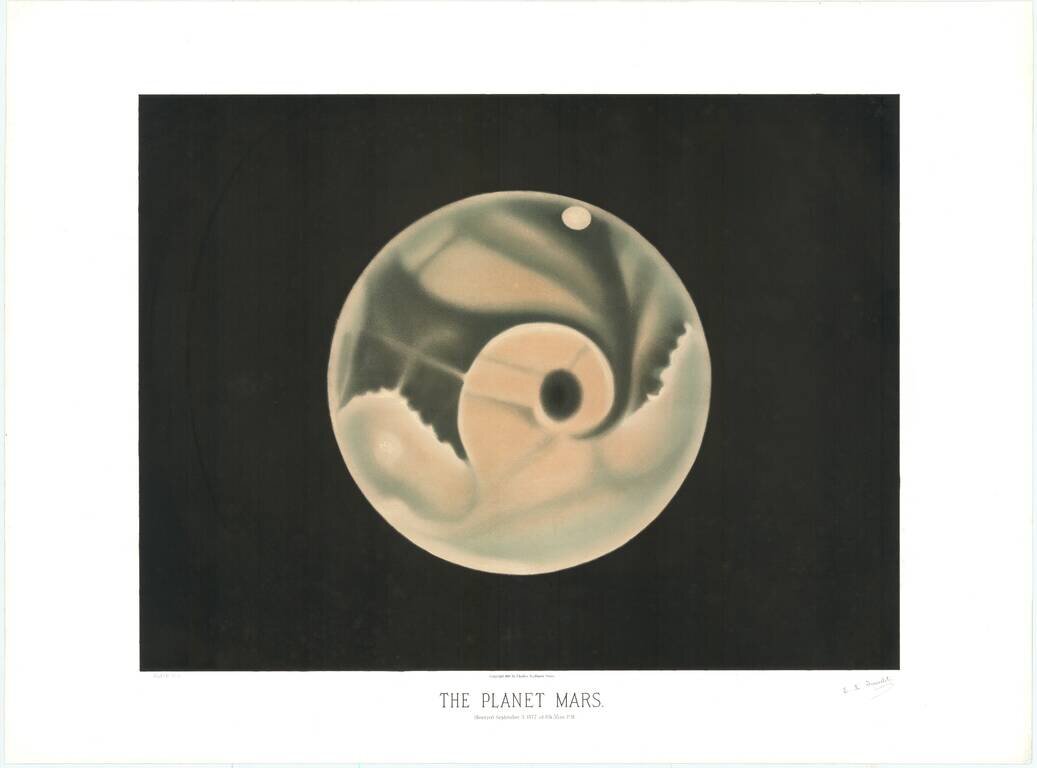
The Best Lithograph Ever Made of the Planet Mars. Made by the "Audubon of the Sky", Etienne Trouvleot.
Beautiful four-stone color lithograph of the planet Mars, by Etienne Trouvelot, relating his observations during the Great Martian Opposition of 1877, an event that sparked decades of intense study of the planet.
The chromolithograph was published as part of Trouvelot's Astronomical Drawings set of 15 plates by Charles Scribner's Sons in 1882.
The Great Opposition of 1877
The lithograph was made from a drawing done by Trouvelot on September 3rd, 1877, at 11:55 PM, during the so-called "Great Opposition" of Mars. That event was extremely important to the early study of Mars because of the unusual proximity of the planet vis-a-vis Earth. This allowed for improved observation of Mars, especially since new, more powerful telescopes (such as the 26-inch refractor at the U.S. Naval Observatory) had gone into operation since the last opposition in 1860.
Trouvelot made his observation two days before Mars was in total perihelic opposition on September 5. At that point, it was only 35 million miles away from earth.
The Opposition of 1877 resulted in two major discoveries and several other important findings. The most important was Asaph Hall's discoveries of Mars's two moons, Phobos and Deimos. Giovanni Virginio Schiaparelli, the Italian astronomer, made a landmark study of the planet during the opposition, which resulted in his discovery of the Martian canali (or channels), which became popularly known as the Martian canals, and led to decades of theories about life on Mars.
Percival Lowell continued the work of studying the Martian channel structures in the 1890s from a private observatory in Flagstaff, Arizona. His drawings of the planet are redolent of Trouvelot's and we can infer an influence.
Nathaniel Green, another artist and amateur astronomer, made observations of Mars from Madiera, using a 13-inch refractor. He drew a fairly detailed map of the surface.
Rarity
Trouvelot's prints were originally intended for the astronomical and scientific community and most of the larger US observatories purchased copies of the portfolio. In 2002, B.G. Corbin undertook a census to determine the number of surviving copies of the complete set of 15 prints and was only able to confirm the existence of 4 complete sets.
Today, the individual prints are even rarer than the complete sets; we find no instances of the present print having been offered separately either by a dealer or at auction.
If you are a student, write to us in telegram: @antiquemaps and indicate what material you need and for what work you need a map in high detail. We are ready to provide material on special terms. For students only!