Map size in jpg-format: 91.1604MiB
Click to open in high resolution (open in new tab).
The Stormy Planet Portrayed by the Audubon of the Sky
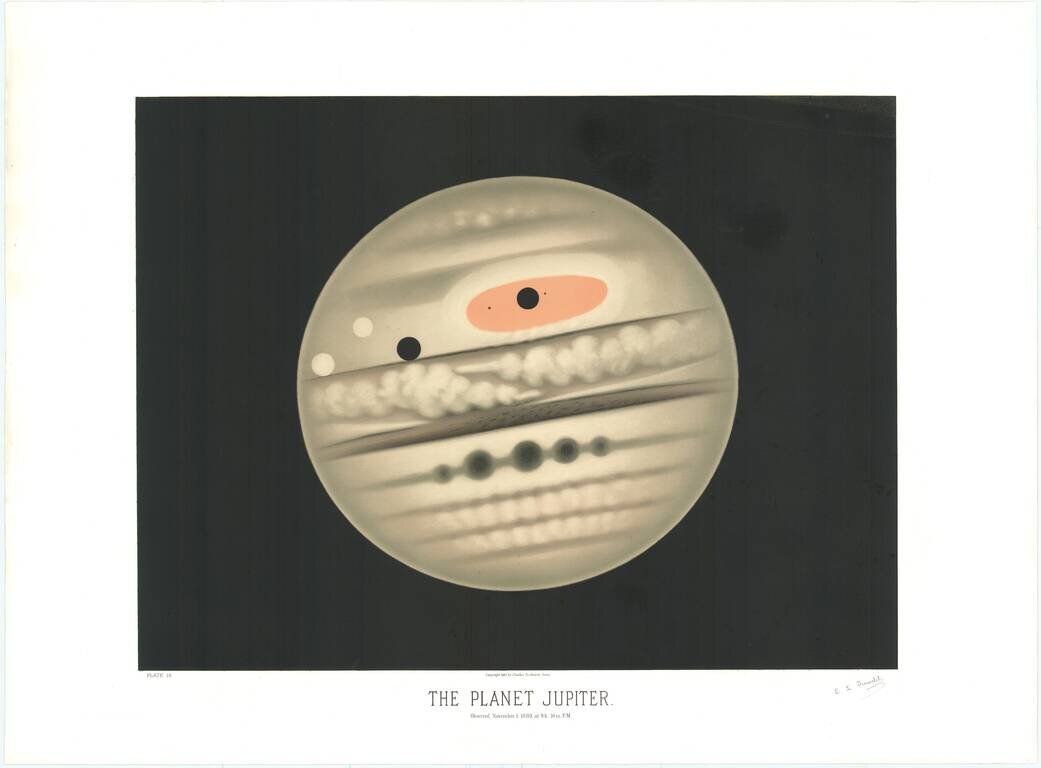
This is a rare chromolithograph of Jupiter from Etienne Leopold Trouvelot's original work depicting celestial bodies, published in 1882.
Trouvelot's portfolio is a work of artistic brilliance far ahead of its time; many of the plates are redolent of the most dramatic and engaging modernist paintings of the following century. In addition to its aesthetic qualities, it is a scientific work of great importance; Trouvelot's magnum opus stands a superlative celestial atlas and one of the most impressive American color plate books ever published.
The plates were lithographed by Armstrong and Company of Boston under Trouvelot's personal supervision. Some of the plates can be directly attributed to the lithographic artist E. Boyd Smith. An estimated 300 sets of the prints were sold as a portfolio for $125, although in a recent census only four complete sets of plates were found in institutions (see note on rarity). Trouvelot combined to a rare degree the qualities of an excellent observer and the skill of an accomplished artist. Solon Bailey stated: "Trouvelot made beautiful drawings of various other celestial objects, including total eclipses of the Sun, the surface of the moon, planets, comets and nebulae. These drawings show rare artistic ability."
As noted by Backhus and Fitch (p. 12):
To ensure exactness with his drawings, Trouvelot used a grid system positioned at the prime focus of his observing telescope. As a testimony to his accuracy relative to star positions, one analysis concludes that Trouvelot's drawings of star positions near the Orion nebula were within 6 arc seconds of actual star positions Trouvelot's first astronomical paper was published in 1875 in the Proceedings of the American Academy of Sciences on the topic of veiled solar spots.Historian B.G. Corbin points out that an early form of astronomical photography became available during the time when Trouvelot was working, but that the artist rejected the idea of switching media, arguing that "the camera could not replace the human eye" when it came to capturing the subtleties of structure and configuration. Trouvelot himself noted:
Although photography renders valuable assistance to the astronomer in the case of the Sun and Moon... for other subjects, its products are in general so blurred and indistinct that no details of any great value can be secured. A well trained eye alone is capable of seizing the delicate details of structure and of configuration of the heavenly bodies, which are liable to be affected, and even rendered invisible, by the slightest changes in our atmosphere. (Trouvelot 1882, p. v).The Dictionary of Scientific Biography notes:
Except for Rutherford's wet-plate photographs of the sun and moon, made in 1865, Trouvelot's drawings were considered the most accurate pictures of celestial objects available until the perfection of dry-plate photography. (DSB XIII, 472)His artistic genius received wide acclaim, with examples of his drawings appearing for public display. For example, several drawings were displayed at the United States Centennial Exhibition in 1876 in Philadelphia as part of the Naval Observatory exhibit. It became apparent that the best way to reach a wider audience was to seek a publisher to produce a printed selection of his monumental works. Trouvelot decided to bring his drawings to the New York publisher Charles Scribner's Sons to be transformed into chromolithographs, a process he supervised closely.
The Fifth Planet from the Sun
Trouvelot's portrayal of Jupiter is magnificent. Readily visible are the many storm systems on the planet, and the atmosphere of Jupiter is one of the most interesting parts of the planet. High and low-pressure systems, upwelling bands, anticyclonic storms, and much more can be found all over the planet. The Great Red Spot, prominently featured in this work, has been known to exist since at least 1830, if not much earlier. The storm is ten thousand miles across, large enough to encompass all of Eurasia. Still little is known about the storm, or the many other weather systems on the planet, despite the extensive study regarding their nature.
Trouvelot's work was published shortly before the confirmation moons other than the Galilean moons. The four moons that were already known, first described by Galileo, are much larger than the rest. In 1892, E. E. Barnard observed Amalthea. It is unclear if the dark spots shown and mentioned in Trouvelot's manual could be additional moons.
Trouvelot describes the work and phenomenon as follows in his Trouvelot Astronomical Drawings Manual:
This planet is perpetually wrapped in dense clouds which hide its inner globe from view. The drawing shows Jupiter’s outer clouded surface with its usual series of alternate light and dark belts, the disk as a whole appearing brighter in the centre than near the limb. The darker gray and black markings indicate in general the lower cloud-levels; that is, partial breaks or rifts in the cloudy envelope, whose prevailing depth apparently exceeds four thousand miles. While the deepest depression in the cloudy envelope is within the limits of the Great Red Spot, the vision may not even here penetrate very deeply. Two of Jupiter’s four moons present bright disks near the planet’s western limb, and cast their shadows far eastward on the disk, that of the “second satellite” falling upon the Red Spot. On the Red Spot are seen in addition two small black spots, no explanation of which can yet be offered. The broad white ring of clouds bordering the Red Spot appeared in constant motion. The central, or equatorial belt, shows brilliant cloudy masses of both the cumulus and stratus types, and the underlying gray and black cloudy surfaces are pervaded with the pinkish color characteristic of this belt. The dark circular spots on the wide white belt next north showed in their mode of formation striking resemblances to sun-spots. They afterward coalesced into a continuous pink belt. The diffusion of pinkish color over the three northern most dark bands, as here observed, is unusual. About either pole is seen the uniform gray segment or polar cap. The equatorial diameter is noticeably longer than the polar diameter, a consequence of the planet’s extraordinary swiftness of rotation. To the same cause may also be due chiefly the distribution of the cloudy belts parallel to the planet’s equator, though the analogy of the terrestrial trade-winds fails to explain all the observed phenomena.
Rarity
Trouvelot's prints were originally intended for the astronomical and scientific community and most of the larger US observatories purchased copies of the portfolio. In 2002, B.G. Corbin undertook a census to determine the number of surviving copies of the complete set of 15 prints and was only able to confirm the existence of 4 complete sets.
If you are a student, write to us in telegram: @antiquemaps and indicate what material you need and for what work you need a map in high detail. We are ready to provide material on special terms. For students only!