Map size in jpg-format: 94.6204MiB
Click to open in high resolution (open in new tab).
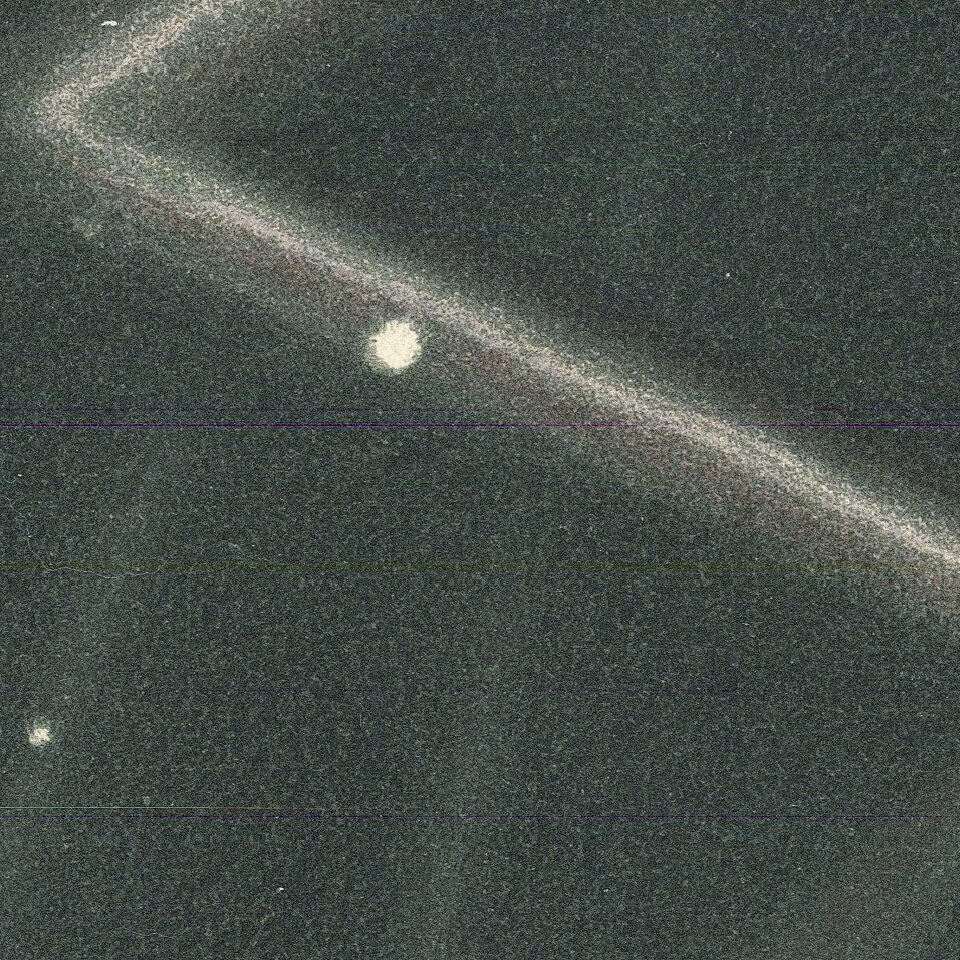
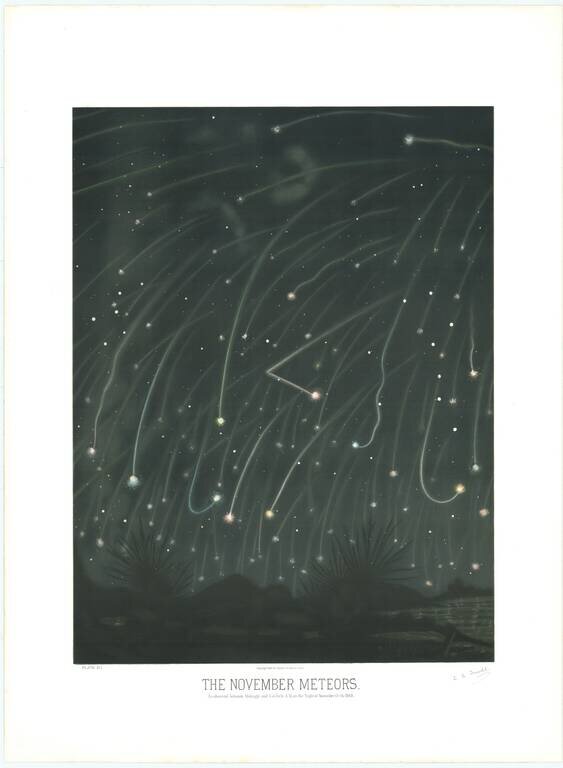
A Remarkable Portrayal of the Leonids, made by the "Audubon of the Sky", Etienne Trouvelot.
This is a beautiful color lithograph showing a meteor shower, made by Etienne Trouvelot and relating his observations made one night in November of 1868. The chromolithograph was published as part of Trouvelot's Astronomical Drawings set of 15 plates by Charles Scribner's Sons in 1882.
Trouvelot's drawings are known as some of the best images of the sky ever made. Trouvelot's work was very important at the time, as it provided important images of the stars, planets, and phenomena of the sky at a time when popular interest in astronomy was growing, but photography had not yet become advanced enough to capture such dark images. Trouvelot's images are recognized as the last of the great images of the night sky that surpassed the photography of their day.
"Stars were falling and random, speeding along brief vectors from their origins in night to their destinies in dust and nothingness" -- Cormac McCarthy's Description of the Leonides
The present image shows the Leonides, a meteor shower that occurs regularly in November. As the earth crosses the trajectory of the comet Tempel-Tuttle, the debris left behind by the passage of the comet rains down on the earth. The shower draws its name for the constellation Leo, from which it is radiant.
The Leonides are strongest approximately once every 33 years, coinciding with the period of its parent comet. The 1833 shower first drew popular attention to the phenomena and was particularly strong in North America. This event featured often in the literature of the time, Faulkner cites 1833 as "Yr. stars fell" in Go Down, Moses. Trouvelot completed his work two years after the large 1866 event and portrayed meteors that fell over the course of five hours.
Trouvelot provides a useful description of the phenomena shown as follows in his Trouvelot Astronomical Drawings Manual:
A partially ideal view of the November Meteors, combining forms observed at different times during the night of Nov. 18th, 1868. It is not, however, a fanciful view, since a much larger number of meteors were observed falling at once during the shower of November, 1833, and at other times. The locality of the observation is shown by the Polar Star seen near the centre of the Plate, and Cassiopeia’s Chair at the left. The general direction of the paths of the meteors is from the north-east, the radiant point of the shower having been in the constellation Leo, beyond and above Ursa Major. While the orbits of the meteors are, in general, curved regularly and slightly, several are shown with very eccentric paths, among them one which changed its course at a sharp angle. In the upper left-hand corner appear two vanishing trails of the “ring-form,” and several others still further transformed into faint luminous patches of cloud. Red, yellow, green, blue and purple tints were observed in the meteors and their trails, as represented in the Plate.
Rarity
Trouvelot's prints were originally intended for the astronomical and scientific community and most of the larger US observatories purchased copies of the portfolio. In 2002, B.G. Corbin undertook a census to determine the number of surviving copies of the complete set of 15 prints and was only able to confirm the existence of 4 complete sets.
If you are a student, write to us in telegram: @antiquemaps and indicate what material you need and for what work you need a map in high detail. We are ready to provide material on special terms. For students only!