Map size in jpg-format: 80.2751MiB
Click to open in high resolution (open in new tab).
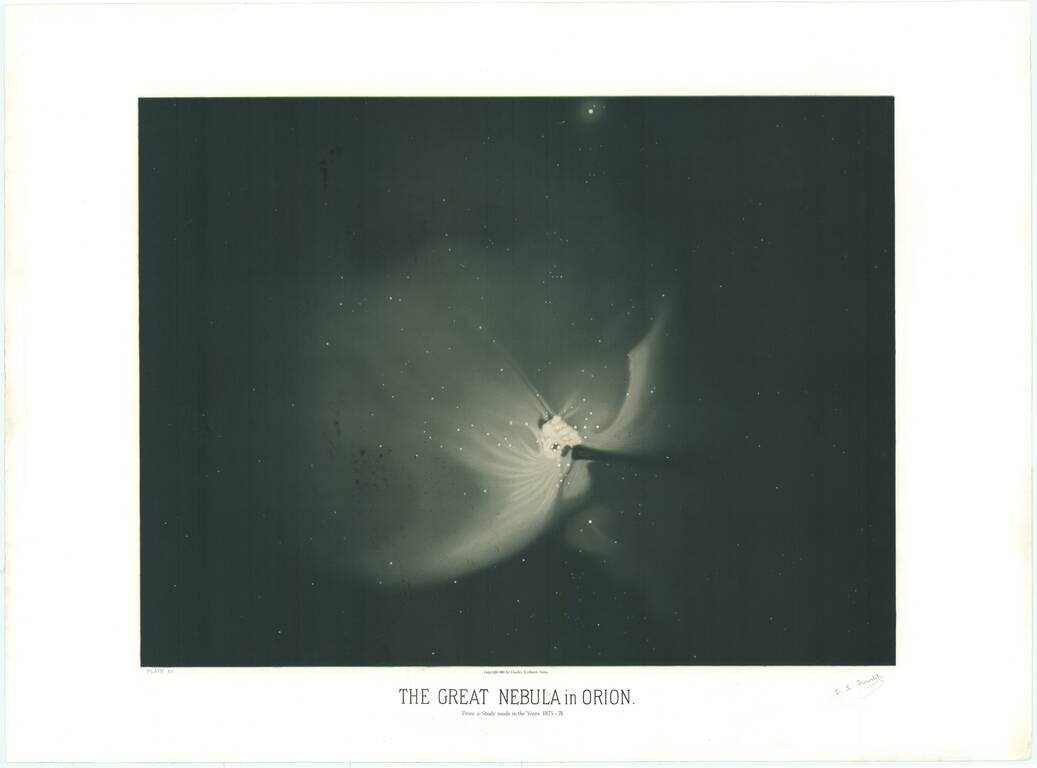
A Magnificent Depiction of Orion's Nebula. Made by the "Audubon of the Sky", Etienne Trouvelot.
This is a beautiful color lithograph showing Orion's Nebula made by Etienne Trouvelot, relating his observations made in the fall of 1874. The chromolithograph was published as part of Trouvelot's Astronomical Drawings set of 15 plates by Charles Scribner's Sons in 1882.
Trouvelot's drawings are known as some of the best images of the sky ever made. Trouvelot's work was very important at the time, as it provided important images of the stars, planets, and phenomena of the sky at a time when popular interest in astronomy was growing, but photography had not yet become advanced enough to capture such dark images. Trouvelot's images are recognized as the last of the great images of the night sky that surpassed the photography of their day.
The object shown is a vast swath of gas and dust spread about the night sky, twenty-four light-years across. Like all nebula, it represents a part of space where planets and stars are born. Some of the youngest stars in the galaxy are in Orion's belt. As the gas cloud cools, it collapses on itself, amassing to create objects. Due to the vast amounts of energy and loose gas, amazing phenomena occur as streams of particles and young stars collide. The nebula exists on a time scale not that different that of the existence of humans. The nebula formed around the timing of the oldest human fossils, and will only exist as it does now for less than a hundred thousand additional years.
Trouvelot provides a useful description of the objects shown as follows in his Trouvelot Astronomical Drawings Manual:
This nebula, which is one of the most brilliant and wonderful of telescopic objects, readily visible to the naked eye as a patch of nebulous light immediately surrounding the middle star of the three which form the sword of Orion, and a little south of the three well-known stars forming the belt. The small stars in this, as in other Plates of the series, are somewhat exaggerated in size, as was unavoidable with any mode of reproduction that could be employed. The bright pentagonal centre of the nebula is traversed by less luminous rifts, the several subdivisions thus outlined being irregularly mottled as if by bright fleecy clouds. Toward the lower part of this bright pentagonal centre is a comparatively dark space containing four bright stars which form a trapezium and together constitute the quadruple star Theta Orionis, which, to the naked eye, appears as the single star in the centre of the sword. On three sides of the central mass extend long bright wisps, whose curves fail, however, to reveal the spiral structure often attributed to this nebula. On the east a broad wing, with wave-shaped inner border, stretches southward. East of the trapezium are two especially noticeable dark spaces. Close to the main nebula on the north-east, a small faint nebula surrounds a bright star, and a branch from another faint stream of nebulous matter forming a loop to the southward, encloses the nebulous star (Iota Orionis) shown at the top of the Plate.
Rarity
Trouvelot's prints were originally intended for the astronomical and scientific community and most of the larger US observatories purchased copies of the portfolio. In 2002, B.G. Corbin undertook a census to determine the number of surviving copies of the complete set of 15 prints and was only able to confirm the existence of 4 complete sets.
If you are a student, write to us in telegram: @antiquemaps and indicate what material you need and for what work you need a map in high detail. We are ready to provide material on special terms. For students only!