Map size in jpg-format: 16.0411MiB
Click to open in high resolution (open in new tab).
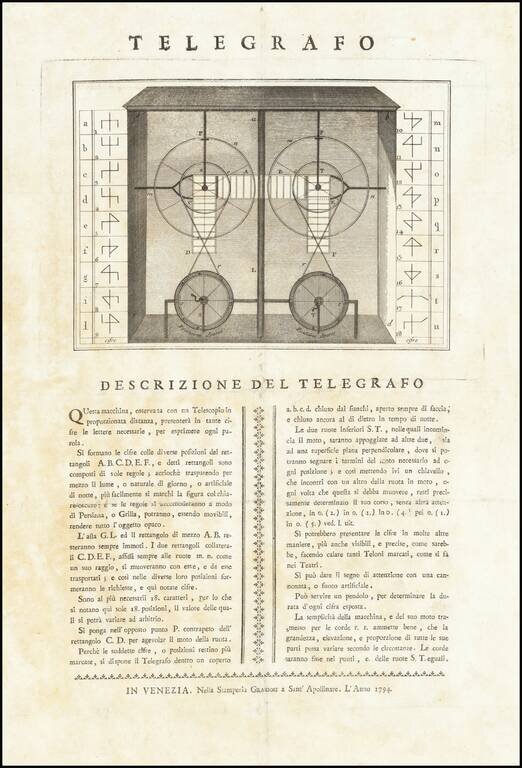
An Early Plan for an Alternative Semaphore Design
This work presents a new type of semaphore in which the operator rotates two wheels in order to create a symbol. In such a way, eighteen letters of the alphabet can be signaled. A sketch of this semaphore (known as a telegraph at the time) is accompanied by Italian text describing its usage.
The design itself is visually attractive, and the concept is simple. By observing the machine through a telescope, information could be passed quickly over several kilometers. With a series of these contraptions, messages could be relayed from one city to the next.
The choice of this design is intriguing. As noted further below, operational semaphores which could express all twenty-six letters as well as ten digits were already in use by the time this text was published. This machine can only convey 18 letters, and it is unclear what would be done to represent the missing eight. The intricacy of the design would also limit the size of the contraption, meaning that more stations would have to be built. It is unclear if the superior mechanisms invented two years prior elsewhere in Europe were already known in Italy, or if they were considered state secrets.
The text goes into depth about how this machine can be better used. A cannon can be fired each time a signal is to be sent, or a pendulum to know how long to leave the signals aloft for. The author even purports to have a way to transmit messages at night, but it is unclear if this would work.
The Semaphore
The idea of transmitting messages at long distances quicker than people could travel was popular since at least the mid-18th century. One of the first recorded semaphores was used for indicating horse racing results and was simply rotating pointer which could indicate eight different outcomes.
Claude Chappe developed a more efficient semaphore in 1791. This design relied on a series of arms that could be individually rotated and displaced to form a series of different symbols. Operated from two levers, it was not vastly different from the system shown here. However, Chappe's setup allowed for a great deal more combinations.
The Chappe semaphore would be used to great success in the French Revolutionary and Napoleonic Wars. A national system of semaphore stations was completed in 1792 and was soon after used to transmit messages all over the country. News of French victories and defeats could reach Paris in less than an hour, while central orders and decrees could be relayed to the provinces just as quickly.
After the system's success in the wars of the Revolution, this design continued to be used for half a century throughout Europe and in colonies. Each country had its own system, though none ever became as extensive as the French one. These semaphores helped to develop techniques used in electrical telegraphs, with this machine being associated with the invention of control flow, redundancy use, and even wire fraud.
If you are a student, write to us in telegram: @antiquemaps and indicate what material you need and for what work you need a map in high detail. We are ready to provide material on special terms. For students only!