Map size in jpg-format: 94.3657MiB
Click to open in high resolution (open in new tab).
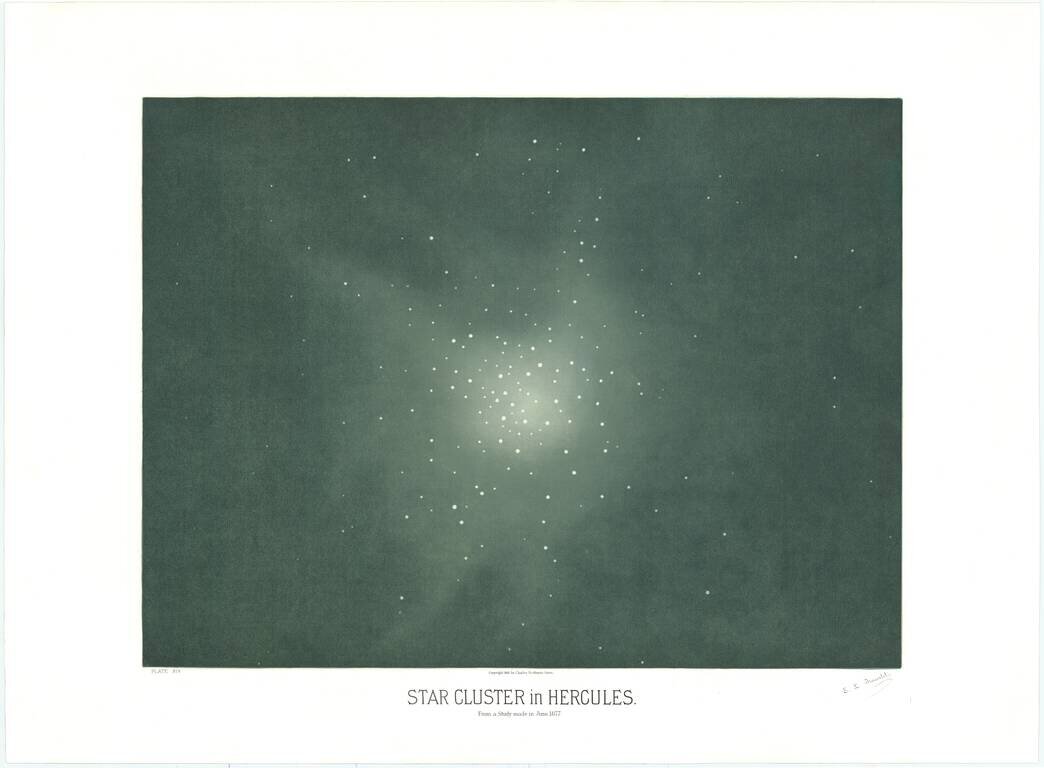
A Remarkable Portrayal of the Hercules Cluster - Messier 13 - made by the "Audubon of the Sky", Etienne Trouvelot.
This is a beautiful color lithograph showing the Messier 13 star cluster, made by Etienne Trouvelot and relating his observations made in the early summer of 1877. The chromolithograph was published as part of Trouvelot's Astronomical Drawings set of 15 plates by Charles Scribner's Sons in 1882.
Trouvelot's drawings are known as some of the best images of the sky ever made. Trouvelot's work was very important at the time, as it provided important images of the stars, planets, and phenomena of the sky at a time when popular interest in astronomy was growing, but photography had not yet become advanced enough to capture such dark images. Trouvelot's images are recognized as the last of the great images of the night sky that surpassed the photography of their day.
The Hercules Cluster, more commonly known by its scientific name Messier 13, is a grouping of hundreds of thousands of stars visible in the constellation of Hercules. First discovered in 1714 by Edmond Halley, it remains an often studied part of the night sky. The distribution of stars in this area is over a hundred times denser than that in the vicinity of our sun. To the naked eye, it appears as a single star or nebula.
Trouvelot provides a useful description of the objects shown as follows in his Trouvelot Astronomical Drawings Manual:
In the constellation Hercules, a small nebulous mass is faintly visible to the eye, a telescopic view of which is presented in Plate XIV. It is one of the most beautiful of the easily resolvable globular clusters. The brilliancy of the centre gives the cluster a distinctly globular appearance, while the several wings curving in various directions, have suggested to some observers an irregularly spiral structure. The large stars of the cluster are arranged in several groups which correspond, in a general way, with the faintly luminous wings.
Rarity
Trouvelot's prints were originally intended for the astronomical and scientific community and most of the larger US observatories purchased copies of the portfolio. In 2002, B.G. Corbin undertook a census to determine the number of surviving copies of the complete set of 15 prints and was only able to confirm the existence of 4 complete sets.
If you are a student, write to us in telegram: @antiquemaps and indicate what material you need and for what work you need a map in high detail. We are ready to provide material on special terms. For students only!