Map size in jpg-format: 89.8544MiB
Click to open in high resolution (open in new tab).
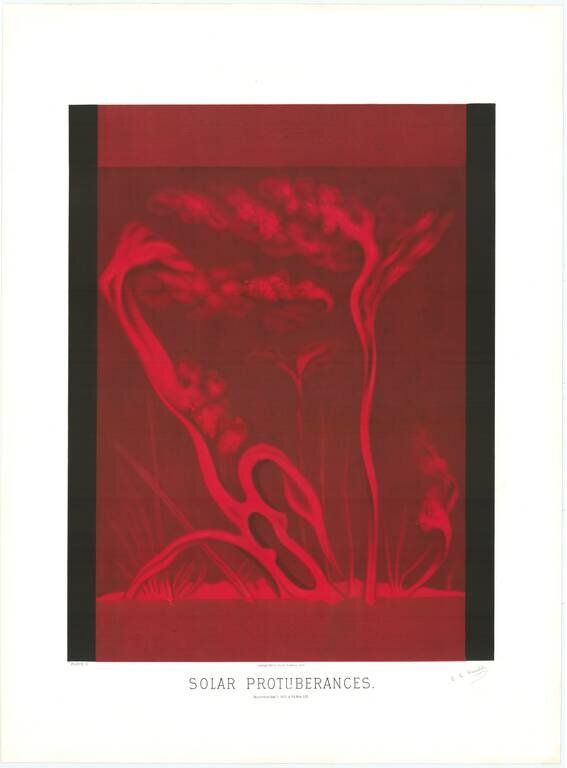
A Magnificent Depiction of a Solar Prominence. Made by the "Audubon of the Sky", Etienne Trouvelot.
This is a beautiful color lithograph showing ejections from the outermost layer of the sun, made by Etienne Trouvelot and relating his observations made in the spring of 1873. The chromolithograph was published as part of Trouvelot's Astronomical Drawings set of 15 plates by Charles Scribner's Sons in 1882.
Trouvelot's drawings are known as some of the best images of the sky ever made. Trouvelot's work was very important at the time, as it provided important images of the stars, planets, and phenomena of the sky at a time when popular interest in astronomy was growing, but photography had not yet become advanced enough to capture such dark images. Trouvelot's images are recognized as the last of the great images of the night sky that surpassed the photography of their day.
"Flame-Like Tongues of Live Embers"
Solar prominences are vast structures, hundreds of thousands of miles in length, which are often loop-shaped. These extensions of cooler plasma are still mysterious, and while their properties are somewhat understood, why they form is not. They exist for weeks to months and can produce coronal mass ejections.
Records of observed solar protuberances exist from at least the 12th century, if not earlier. These are most obviously visible during eclipses, and by the 18th century they were studied regularly. The first hypothesis as to their existence was that they were clouds in the lunar atmosphere. Trouvelot apparently did not base his work solely off of an eclipse, with his date of May 5th, 1873 not corresponding to an ecliptical date, though he did make some relevant observations during the May 5th, 1878 lunar eclipse.
Trouvelot provides a useful description of the phenomena shown as follows in his Trouvelot Astronomical Drawings Manual:
A view of an upheaval of the chromosphere, or third outlying envelope of the sun, as observed with the…telescope with spectroscope attached.
The black background represents the general darkness of the eye-piece to the spectroscope. The broad red stripe stretching from top to bottom of the Plate is a portion of the red band of the spectrum, magnified about 100 times as compared with the actual spectroscopic view. The upper and lower edges of the cross-section of dusky red correspond with the edges of the slit, opened widely enough to admit a view of the chromospheric crest and of the whole height of the protuberance at once. With a narrower opening of the slit this background would have been nearly black, its reddish cast increasing with the amount of opening and consequent admission of diffused sun-light. Rising above the lower edge of the opening is seen a small outer segment of the chromosphere, which, as a portion of the sun’s eastern limb, should be imagined as moving directly towards the beholder. The seams and rifts by which its surface is broken, as well as the distorted forms of the huge protuberances show the chromosphere to be in violent agitation. Some of the most characteristic shapes of the eruptive protuberances are presented, as also cloud-like forms overtopping the rest. In the immediate foreground the bases of two towering columns appear deeply depressed below the general horizon of the segment observed, showing an extraordinary velocity of motion of the whole uplifted mass toward the observer. The highest of these protuberances was 126,000 miles in height at the moment of observation. The triple protuberance at the left with two drooping wings and a tall swaying spire tipped with a very bright flame, shows by its more brilliant color the higher temperature (and possibly compression) to which its gases have been subjected. The irregular black bands behind this protuberance indicate the presence there of less condensed and cooler clouds of the same gases. The dimmer jets of flame rising from the chromosphere are either vanishing protuberances, or, as in the case of the smallest jet shown at the extreme right of the horizon, are the tops of protuberances just coming into view.
Rarity
Trouvelot's prints were originally intended for the astronomical and scientific community and most of the larger US observatories purchased copies of the portfolio. In 2002, B.G. Corbin undertook a census to determine the number of surviving copies of the complete set of 15 prints and was only able to confirm the existence of 4 complete sets.
If you are a student, write to us in telegram: @antiquemaps and indicate what material you need and for what work you need a map in high detail. We are ready to provide material on special terms. For students only!