Map size in jpg-format: 41.0608MiB
Click to open in high resolution (open in new tab).
"Blood and Soil"
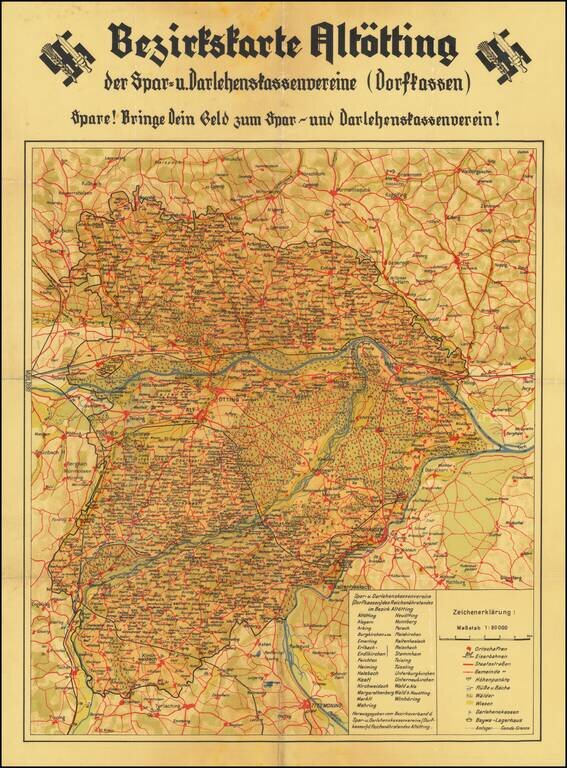
Rare Nazi-era map of the area around Altötting in Bavaria, promoting the deposit of money in Savings and Loan Associations and Credit Unions. This map is part of the ideological propoganda war of "Blood and Soil" waged on the pre-Nazi democratic and collective institutions of agrarian Germany. This map is a prime example of Goebbels's desire to expand propaganda to every facet of life. Not even the structure of credit unions, considered as institutions with democratic tendencies, was exempt from this. The map shows only credit unions run by the Reichsnährstand, a government body set up to regulate the production of food.
Altötting is a small town in southeastern Bavaria on the Austrian border. The region shown in the map at the time would have compromised no more than a few tens of thousands rural agricultural workers and small town residents living in the fertile lands near the Inn River. The alpine Bavarian Free State was a hotbed of extremism in the cities, while the rural parts remained more mainstream conservative and Catholic. These populations, while perhaps not generally critical of the government, would have resented the changes to their traditional way of life during Nazi attempts at restructuring the economy.
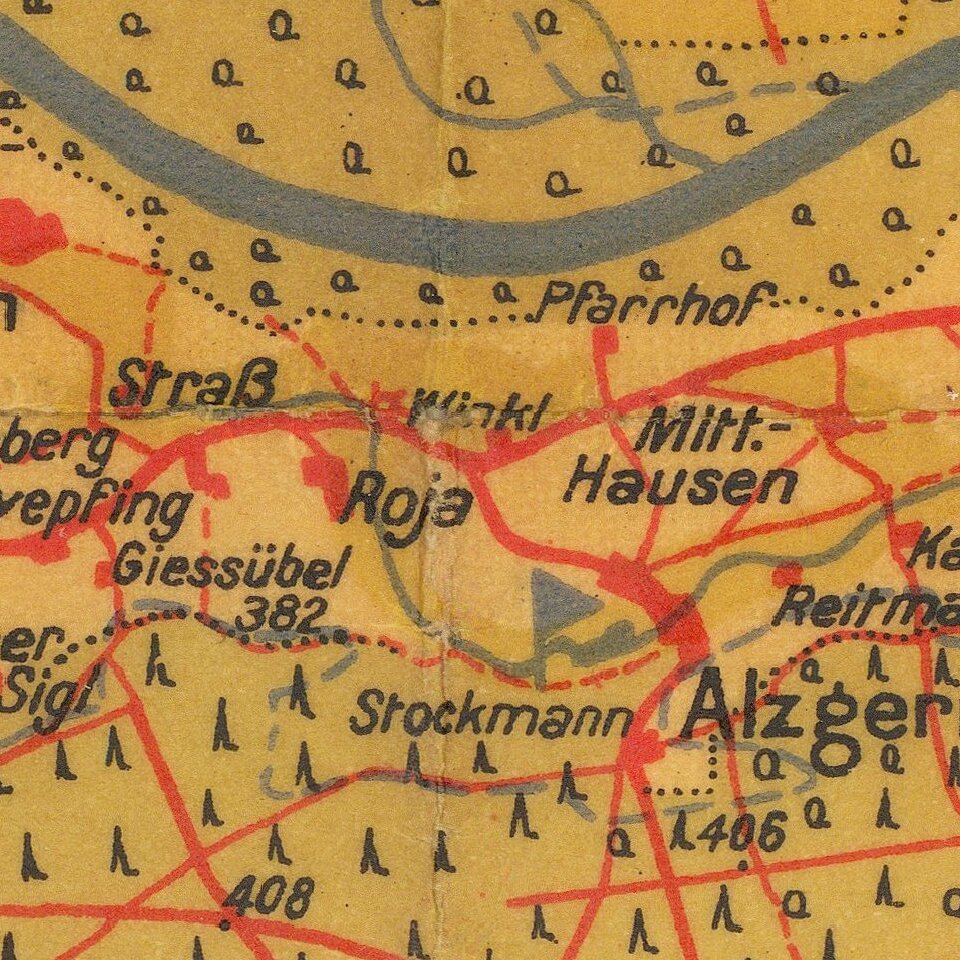
The map includes towns, roads, railroads, rivers, grasslands and, of course, the locations of the Darlehenskassen (Credit Unions) in the area, with nearly 30 locating in just this small area of Bavaria.
The Reichsnährstand
The Blood and Soil ideology was primarily instituted by the Reich Ministry of Food and Agriculture, and in particular by Richard Walker Darré. The central premise of this doctrine was the supposedly inseperable nature of German culture and German farmland. Urban culture was viewed as a weakness, while the ideal of the Christian peasantry was worshipped. While primarily a tool of propoganda, this movement led to some restructuring of agrarian Germany. The symbol of the ideollogy, a Swastika with a wheat ear and a sword, was also the symbol of the Reich Ministry of Food and Agriculture and can be seen on the map.
Tied to the Reich Ministry of Food and Agriculture was the Reichsnahrstand corporation which published this map, both lead by Darré in the 1930's. He was devoted to the idea of a return to the land and a readoption of rural values, and he viewed the peasantry as the only defense against liberallism. Implementation of Darré's ideas required increased state control of agriculture and elimination of liberal tendencies in the peasantry. One manifestation of the democratic tendencies of the peasantry were credit cooperatives, which had to be replaced by state-controlled lending unions. While Darré was succesful in reinvigorating pride in the German peasantry, his controls on the economy led to poor harvests and his eventual removal from power.
History of Credit Unions
The first working credit union models sprang up in Germany in the 1850s and 1860s, and by the end of the 19th century they had taken root in much of Europe. They drew inspiration from cooperative successes in other sectors, such as retail and agricultural marketing (refer to the history of the cooperative movement).
The first successful credit unions began in Germany under the leadership of cooperative pioneer Hermann Schulze-Delitzsch. They adhered to the basic aspects of the co-operative identity: that is, they were “based on the values of self-help, self-responsibility, democracy, equality, equity and solidarity. In the tradition of their founders, co-operative members believe in the ethical values of honesty, openness, social responsibility and caring for others” (Weber and Remer, 2016). Schulze-Delitzsch is credited with developing the bond of association which still forms the legal basis for credit unions today.
While Schulze's credit unions were situated in urban areas and served traders, shop owners and artisans, Friedrich Wilhelm Raiffeisen founded the first rural credit union in the village of Heddesdorf (now a suburb of Neuwied) in Germany. Raiffeisen's approach built on many aspects of Schulze's, but with significant modifications that had important implications for microfinance.
By 1913 over 2 million Germans were members of credit unions. Of these, 80% lived in communities with less than 3,000 people. The participation of rural working class customers contradicted the arguments of skeptics who argued that poor people couldn't be relied on to repay their loans, and that no bank could make a profit serving poor Germans.
Credit cooperatives were also a critical lifeline for persecuted minorities even before the rise of Nazism. Jewish Credit Cooperatives provided self-help systems for a community increasingly barred from accessing conventional lines of credit. Until the pogrom of 1938, these cooperatives provided an income for Jewish families, and decreasing their success was a Nazi party priority.
During World War II, the German cooperative movement was destroyed by Nazism. Because they were decentralized and democratic, the cooperatives often supported anti-Nazi political groups. As such, the Nazi regime completely dismantled and destroyed the systems in urban Germany. While the rural systems survived slightly better, the ravages of war on the German agrarian economy decimated these collectives.
If you are a student, write to us in telegram: @antiquemaps and indicate what material you need and for what work you need a map in high detail. We are ready to provide material on special terms. For students only!