Map size in jpg-format: 85.7728MiB
Click to open in high resolution (open in new tab).
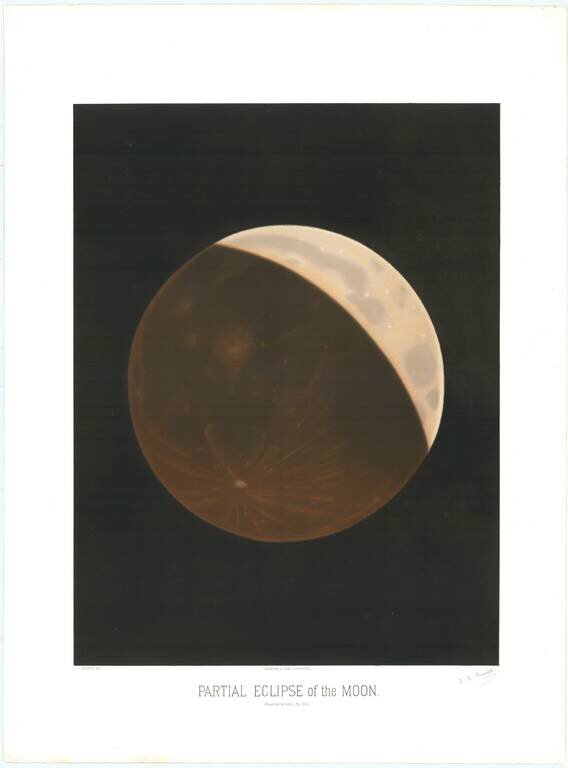
A Stunning Lithograph of the Moon Showing a Partial Eclipse. Made by the "Audubon of the Sky", Etienne Trouvelot.
This is a beautiful color lithograph of a partial lunar eclipse made by Etienne Trouvelot, relating his observations made in the fall of 1874. The chromolithograph was published as part of Trouvelot's Astronomical Drawings set of 15 plates by Charles Scribner's Sons in 1882.
Trouvelot's drawings are known as some of the best images of the sky ever made. Trouvelot's work was very important at the time, as it provided important images of the stars, planets, and phenomena of the sky at a time when popular interest in astronomy was growing, but photography had not yet become advanced enough to capture such dark images. Trouvelot's images are recognized as the last of the great images of the night sky that surpassed the photography of their day.
A Blood Moon
Lunar eclipses are magnificent phenomena that happen when the moon passes through the shadow of the sun cast by the earth. The lack of direct sunlight means that only refracted light, which undergoes Rayleigh scattering, reaches the moon from the sun. This results in a deep red color, leading to the term blood moon, and they are also known as blue moons or supermoons.
It is interesting that Trouvelot chooses to portray a partial eclipse. On October 25th, a day after this image was sketched, a full eclipse would occur. Perhaps Trouvelot decided that the contrast between the bright and dark parts of the moon would lead to better understanding on the effects of the blood moon, or perhaps his view was obscured on the second night.
Trouvelot describes the work and phenomenon as follows in his Trouvelot Astronomical Drawings Manual:
A view of the Moon partially obscured by the Earth’s shadow, whose outline gives ocular proof of the earth’s rotundity of form. The shadowed part of the Moon’s surface is rendered visible by the diffused sun-light refracted upon it from the earth’s atmosphere. Its reddish brown color is due to the absorption, by vapors present near the earth’s surface, of a considerable part of this dim light. On both the obscured and illuminated tracts the configurations of the Moon’s surface are seen as with the naked eye. The craters appear as distinct patches of lighter color, and the noticeably darker areas are the depressed plains or Maria. The large crater Tycho, at the lower part of the disk, is the most prominent of these objects, with its extensive system of radiating streaks. The largest crater above is Copernicus, at the left of which is Kepler and still above are Aristarchus and Herodotus appearing as if blended in one. Above and at the left of the great crater Tycho, the first dark tract is the Mare Humorum of Plate VI seen in its natural position, with the crater Gassendi at its northern (upper) extremity and Vitello on its southern (lower) border. The advancing border of the shadow appears, as always, noticeably darker than the remainder, an effect probably of contrast. The illuminated segment of the Moon’s disk has its usual appearance, the lighter portions being the more elevated mountainous surfaces, and the dark spaces the floors of extensive plains.
Rarity
Trouvelot's prints were originally intended for the astronomical and scientific community and most of the larger US observatories purchased copies of the portfolio. In 2002, B.G. Corbin undertook a census to determine the number of surviving copies of the complete set of 15 prints and was only able to confirm the existence of 4 complete sets.
If you are a student, write to us in telegram: @antiquemaps and indicate what material you need and for what work you need a map in high detail. We are ready to provide material on special terms. For students only!