Map size in jpg-format: 85.2417MiB
Click to open in high resolution (open in new tab).
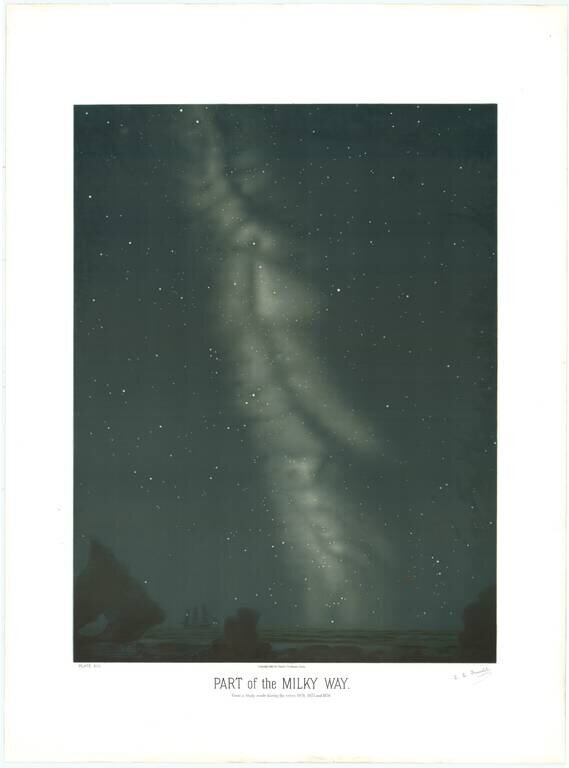
An Excellent and Breathtaking Lithograph of the Milky Way. Made by the "Audubon of the Sky", Etienne Trouvelot.
This is a beautiful color lithograph of the Milky Way, by Etienne Trouvelot, relating his observations made over the course of the years 1874-1876. The chromolithograph was published as part of Trouvelot's Astronomical Drawings set of 15 plates by Charles Scribner's Sons in 1882.
The night sky is stunningly depicted in chromolithography, with the ghostly arms of the milky way running along the vertical center of the image. Bright and faint stars dot the background. In the foreground, a translucent ship sails along the horizon, nestled in clouds. The artistic qualities of the image are stunning.
Trouvelot describes the image in his work The Trouvelot Astronomical Drawings Manual as follows:
The course of the portion of the Galaxy represented in Plate XIII. is as follows: From Cassiopeia’s chair, three bright stars of which appear at the upper edge of the Plate, the Galaxy, forming two streams, descends south, passing partly through Lacerta on the left, and Cepheus on the right; at this last point it approaches nearest to the Polar Star, which is itself outside of the field of view. Then it enters Cygnus, where it becomes very complicated and bright, and where several large cloudy masses are seen terminating its left branch, which passes to the right, near the bright star Deneb, the leader of this constellation. Below Deneb, the Galaxy is apparently disconnected and separated from the northern part by a narrow, irregular dark gap. From this rupture, the Milky-way divides into two great streams, separated by an irregular dark rift. An immense branch extends to the right, which, after having formed an important luminous mass between the stars Gamma and Beta, continues its southward progress through parts of Lyra, Vulpecula, Hercules, Aquila and Ophiuchus, where it gradually terminates a few degrees south of the equator. The main stream on the left, after having formed a bright mass around Epsilon Cygni, passes through Vulpecula and then Aquila, where it crosses the equinoctial just below the star Eta, after having involved in its nebulosity the bright star Altair, the leader of Aquila. In the southern hemisphere the Galaxy becomes very complicated and forms a succession of very bright, irregular masses, the upper one being in Scutum Sobieskii, while the others are respectively situated in Sagittarius and in Scorpio; the last, just a little above our horizon, being always considerably dimmed by vapors. From Scutum Sobieskii, the Galaxy expands considerably on the right, and sends a branch into Scorpio, in which the fiery red star Antares is somewhat involved. In the upper left-hand corner of the Plate, at some distance from the Milky-way, is seen dimly the Nebula in Andromeda, which becomes so magnificent an object to telescopic view.
Rarity
Trouvelot's prints were originally intended for the astronomical and scientific community and most of the larger US observatories purchased copies of the portfolio. In 2002, B.G. Corbin undertook a census to determine the number of surviving copies of the complete set of 15 prints and was only able to confirm the existence of 4 complete sets.
If you are a student, write to us in telegram: @antiquemaps and indicate what material you need and for what work you need a map in high detail. We are ready to provide material on special terms. For students only!