Map size in jpg-format: 8.53479MiB
Click to open in high resolution (open in new tab).
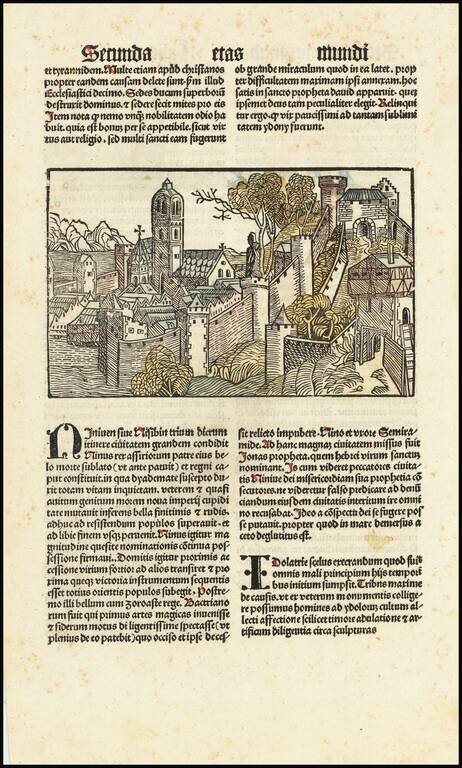
The Second Earliest Printed View of Nineveh
Gorgeous example of Hartmann Schedel's incunable view of the Ancient Assyrian City of Nineveh from the small format edition of Schedel's Liber Chronicum, perhaps the single most influential secular illustrated book of the 15th century and one of the landmark printed works of the 15th century.
Hartmann Schedel (1440-1514) was a physician, book collector, and writer whose most famous work, the Liber Chronicarum (Nuremberg Chronicle), included some of the first printed views of many cities in Europe and across the world.
Schedel was born and died in Nuremberg, but he also traveled for his education. From 1456 to 1463 he lived in Leipzig, where he attended the University of Leipzig and earned his MA. From there he went to Padua, where he earned a Doctor of Medicine in 1466. After university, he worked for a time in Nördlingen and then returned to Nuremberg. In 1482 he was elected a member of the Great Council of Nuremberg.
The Chronicle was published in 1493 and contained 1,800 woodcut images executed by Michael Wohlgemut (1434-1519) and his stepson Wilhelm Pleydenwurff (1460-1494). Wohlgemut’s apprentice, the famous printmaker Albrecht Durer, also likely worked on some of the woodcuts. The work includes large format views of many cities including Rome, Venice, Paris, Vienna, Florence, Genoa, Salzburg, Krakow, Breslau, Budapest, Prague, Jerusalem, Alexandria, Constantinople, as well as a number of towns in what would become the German Empire. A double-page map of the world was also part of the Chronicle’s many illustrations.
Besides the Nuremberg Chronicle, one of Schedel’s most enduring legacies is his magnificent manuscript and printed book collection, one of the largest of the fifteenth century. In 1552, Schedel's grandson, Melchior Schedel, sold about 370 manuscripts and 600 printed works from Hartmann Schedel's library to Johann Jakob Fugger. Fugger later sold his library to Duke Albert V of Bavaria in 1571. This library is now mostly preserved in the Bayerische Staasbibliothek in Munich.
Among the surviving portions of Schedel's library are the records for the publication of the Chronicle, including Schedel's contract with Anton Koberger for the publication of the work and the financing of the work by Sebald Schreyer and Sebastian Kammermeister, as well as the contracts with Wohlgemut and Pleydenwurff for the original artworks and engravings. The collection also includes original manuscript copies of the work in Latin and German.
If you are a student, write to us in telegram: @antiquemaps and indicate what material you need and for what work you need a map in high detail. We are ready to provide material on special terms. For students only!

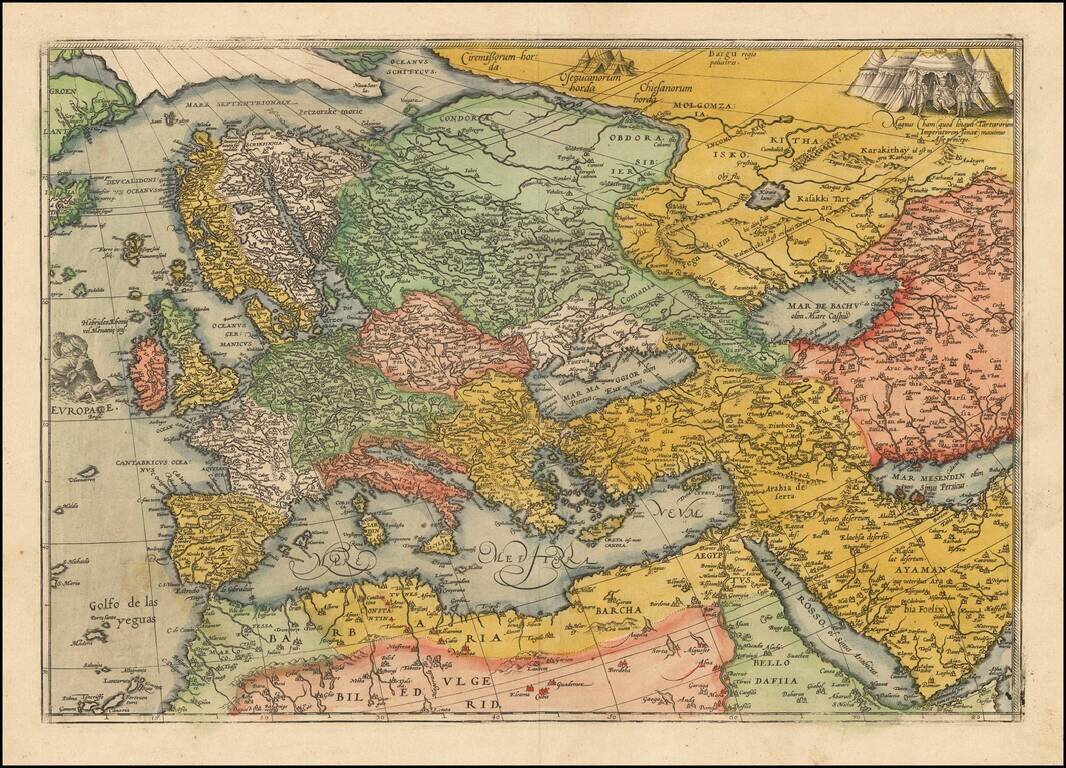
![[Europe, Mediterranean, Asia Minor and the Persian Empire]](/map/small/43558.jpg)