Map size in jpg-format: 1.9297MiB
Click to open in high resolution (open in new tab).
"The first map devoted so much to California"-- Burden
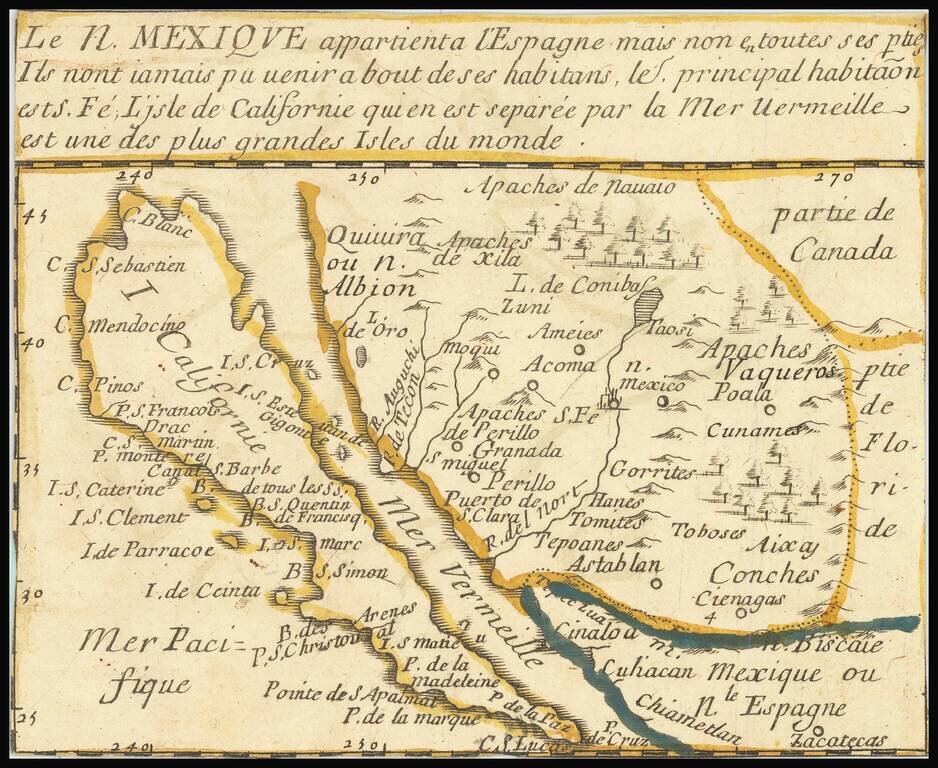
A little, very rare, gem of a map of California as an Island, stretching eastwards into lands little known. Many places throughout this region are named, and colonial claims are shown. A long title devotes itself to explaining the extent of New Mexico, the Island of California ("one of the largest islands in the world"), and the lack of exploration in the region.
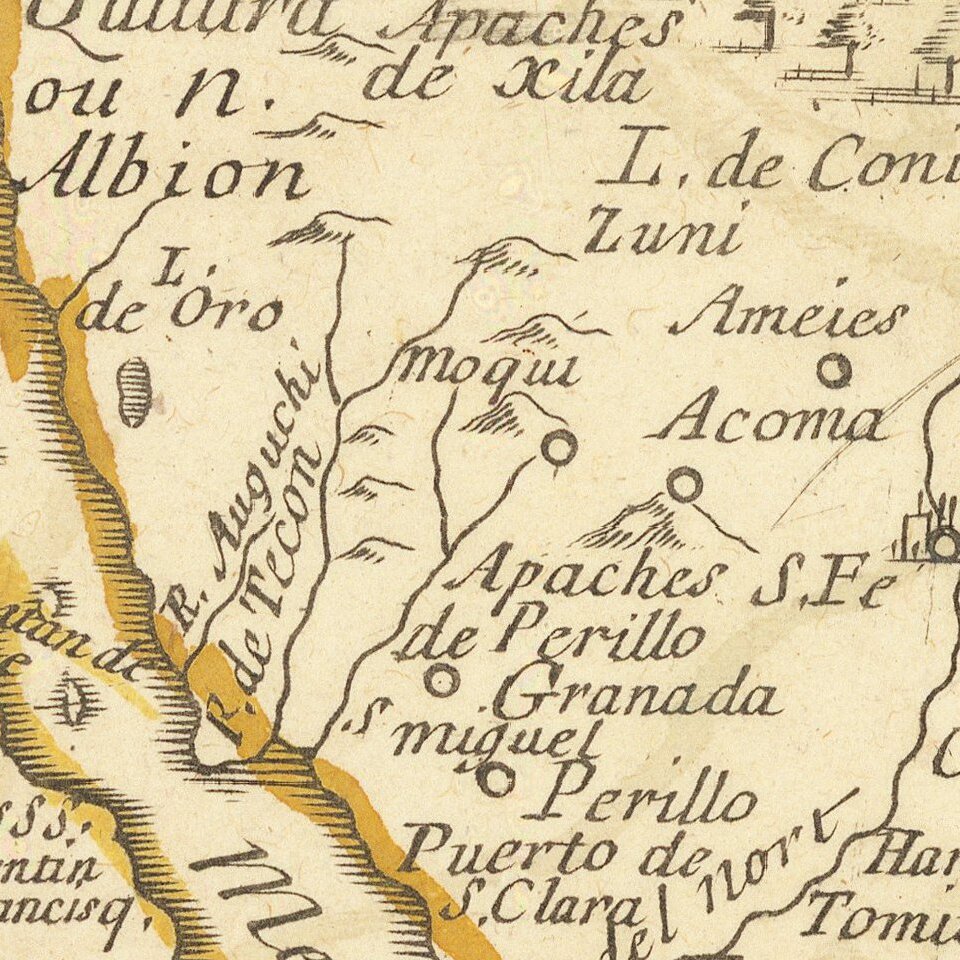
The map is fascinating for many reasons. For one, we see Canada stretching almost into lands controlled by Apache tribes, and Florida reaches a mountain range just east of Santa Fe. The Rio Grande flows past Santa Fe into the Gulf of California ("mer vermeille"). Several still recognizable place names can be found, including "Taosi," "Cinaloa," Zacatecas, though their emplacements appear to be all but guesses. Santa Fe is the only city proper to be seen. The Navajo Apaches are marked as living at a more northern than the Cap Blanc.
Of course, the central interest on the map is the Island of California. Notably, New Albion is labeled on the mainland, even though the Port of Sir Francis Drake is labeled in its "correct" spot. We see many recognizable places along the California coastline, including Cabo San Lucas, Todos Santos Bay, Santa Clemente Island, Santa Barbara, and the Mendocino Cape.
L'Ameriqve par P. Du Val Geographe du Roy
This map is originally from a single engraved sheet appearing alongside seventeen other maps in a work entitled L'Ameriqve Par P. Du Val Geographe du Roy. One map was devoted to the whole American continent, while the others focused on such areas as Newfoundland, the Caribbean, Patagonia, and Columbia. Two particularly notable maps come out of this work, the first of which is the present map of California as an Island, remarkable for its early focus on California. The second is the map entitled La Nvle. Svede, which "could rightly be called the first map of the Delaware River" (Burden 322). Many additional maps are intriguing for other reasons, including portraying the American holdings of such diverse colonial powers as Denmark, Sweden, and Holland.
This work was separately published, and neither Burden nor we are able to ascertain their purpose. The work appeared alongside similar charts of the four then-known continents.
This was printed as part of the second state of this work. Burden notes one example of the first state in Oxford, and two examples of the second state, one in the BNF in Paris, and one in a private American collection. An 1885 source also refers to this map being present in the BNF. An example was offered at auction in 2010, but it is uncertain if this was the same as one of the examples which Burden notes. We have been unable to locate any additional loose examples of these maps outside of the complete sheets.
Burden dates the first state of the map to circa 1656 on the assumption that Duval used many of Sanson's place names from his 1650 and 1656 maps, but not from his 1657 Audience de Guadalajara.
The Controversy Surrounding San Francisco Bay Before 1769
Several mid-17th century maps show Drake's Bay in Northern California and indicate that the port was popularly referred to by the name of St. Francis. For maps created before Gaspar de Portola's supposed 1769 discovery of San Francisco, this raises questions. An analysis of primary sources, including the voyages of Drake, Somenho, Portola, and others, and the maps by authors such as Brigg and Muller, answer some, but not all, questions.
The Drake voyage to California has taken on mythical proportions, repeatedly becoming politicized in the early days of a state which was grasping for an Anglo-centric story of origination. Drake discovered "New Albion" (northern California) during his 1577-1580 privateering circumnavigation. After claiming to have reached 48 degrees north, which would have placed Drake nearly at the entrance of the Salish Sea, Drake was forced to turn the Golden Hinde southwards due to unfavorable winds. His crew spent a month harbored at a good bay supposedly at 38º 30', during which he interacted extensively with the indigenous peoples.
The description for this bay is unusually vague in primary sources of the voyage. In his The World Encompassed, Drake spends twenty pages discussing the many days spent at this bay, but provides few indications of where this spot might actually lie. Two of the only hints in this passage mention that "Not farre without this harborough did lye certaine Ilands (we called them the Illands of Saint James) having on them plentifull and great store of Seales and birds..." and "This country our generall named Albion [an alternative name for Great Britain, with the same root as the Gaelic Alba], and that for two causes; the one in respect of the white bancks and cliffes, which lie toward the sea...."
Using these two pieces of information, alongside the latitude given and the indigenous practices described, which appear to suggest that Drake encountered the Coast Miwok peoples, it has been accepted that Drake landed slightly south of Point Reyes. While this debate is far from resolved (with arguments that Drake arrived in various bays from Washington to even Alaska), it is unlikely that Drake discovered the San Francisco Bay proper, as his text never mentions an inland port.
Drake's was not the only voyage to the region in the late 16th century. Sebastião Rodrigues Soromenho, the Portuguese explorer made landfall at Drake's supposed location. A Spanish Galleon sunk at the site, leaving definitive proof of Soromenho's location. He named the bay San Francisco. Curiously, Soromenho had been sent north to search for a large inland body of water in the area, rumors of which had already reached the Spanish.
Drake's Bay appeared on maps at some location north of Monterey throughout the next century and a half, labeled, for example, as "P. du. S. Fracisque Drac." This can be traced back to Brigg's 1625 America Septentrionalis, with his depiction of California based on "a Spanish Charte taken by ye Hollanders." It is likely that Briggs renamed the bay after Drake in his remapping, though whether this was done erroneously or consciously is unclear. It may be to this false name that the present chart refers.
It is commonly accepted that Juan Crespi named the San Francisco Bay after St. Francis of Assisi, the founder of his order. However, surviving documents are few which describe the earliest days of European exploration in the bay. It was also believed by explorers that the native population had seen European ships in the harbor prior to Portola's arrival, which was why they went to the bay in the first place. These many lines of evidence make one wonder if the name of San Francisco, transliterated from the name of Sir Francis Drake, was already in use regarding the bay prior to 1769.
If you are a student, write to us in telegram: @antiquemaps and indicate what material you need and for what work you need a map in high detail. We are ready to provide material on special terms. For students only!

![Carte Du Mexique et de la Floride des Terres Angloises et des Isles Antilles du Cours et des Environs de la Riviere Mississipi . . . Rue Des Canettes . . . 1703 [1st State]](/map/small/66307op.jpg)