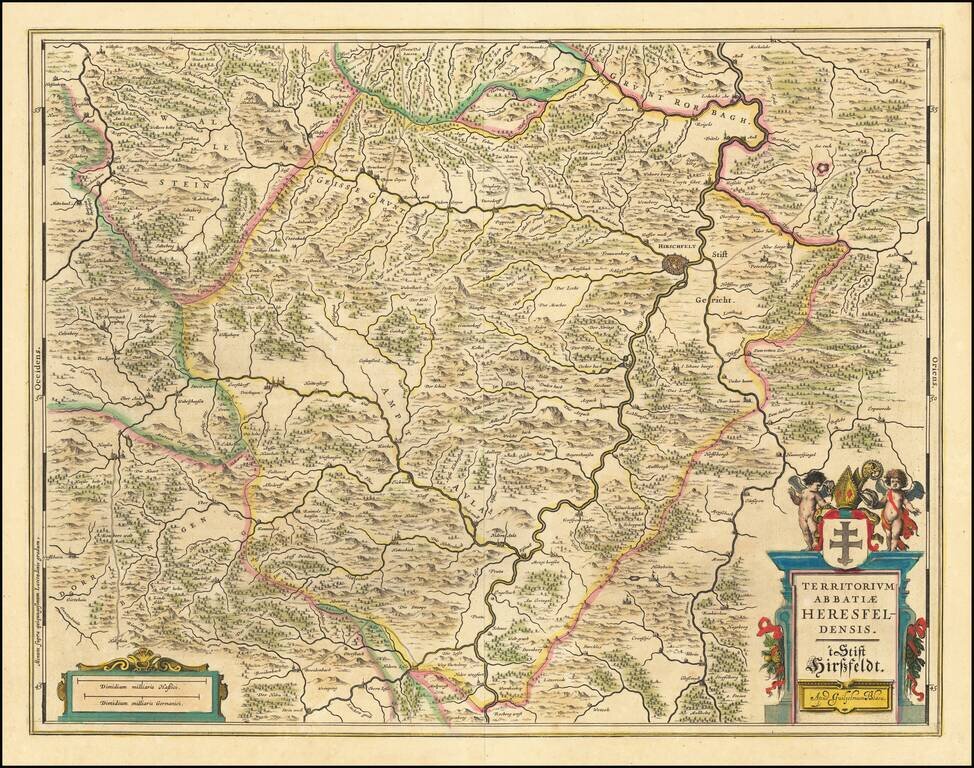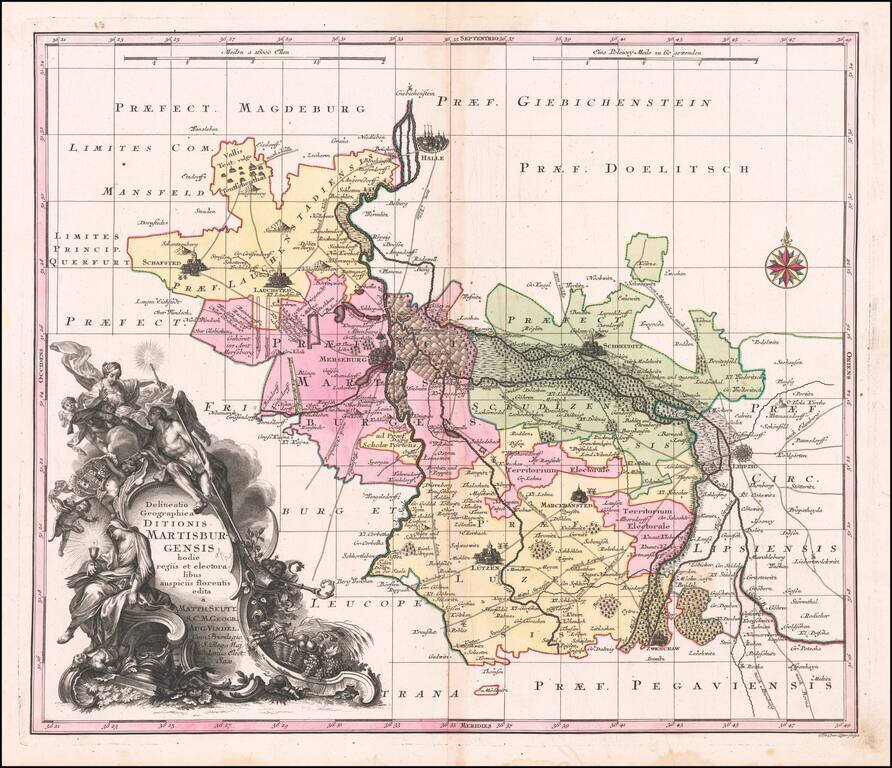
Map size in jpg-format: 1.79756MiB
Click to open in high resolution (open in new tab).
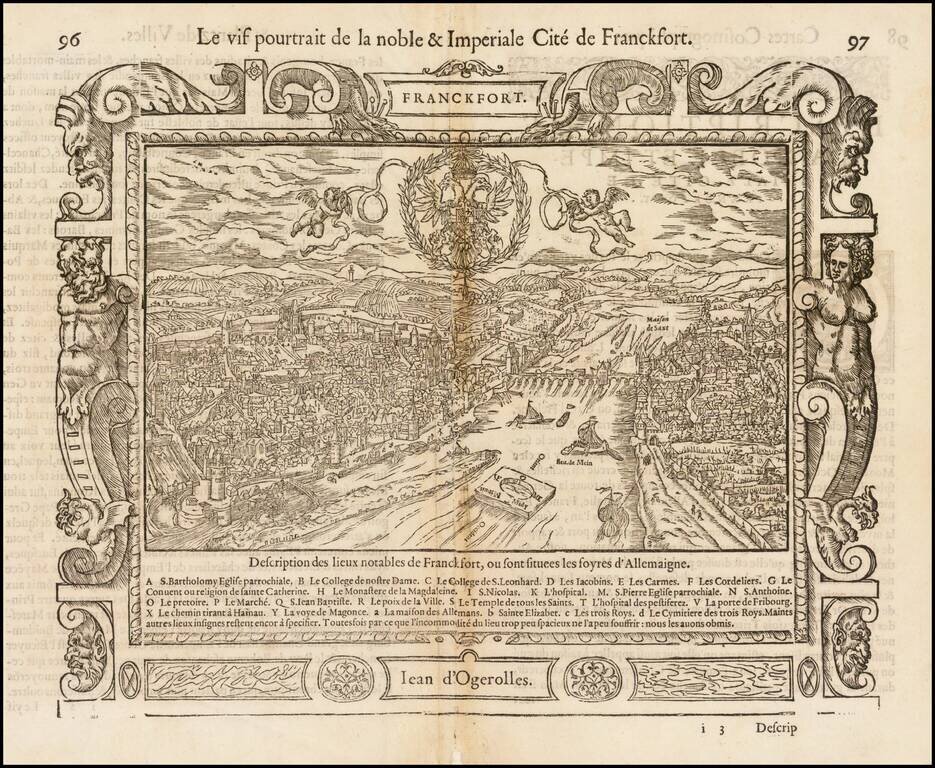
Scarce and higly decorative 16th Century view of Frankfurt by Guillaume Guéroult, printed in Lyon.
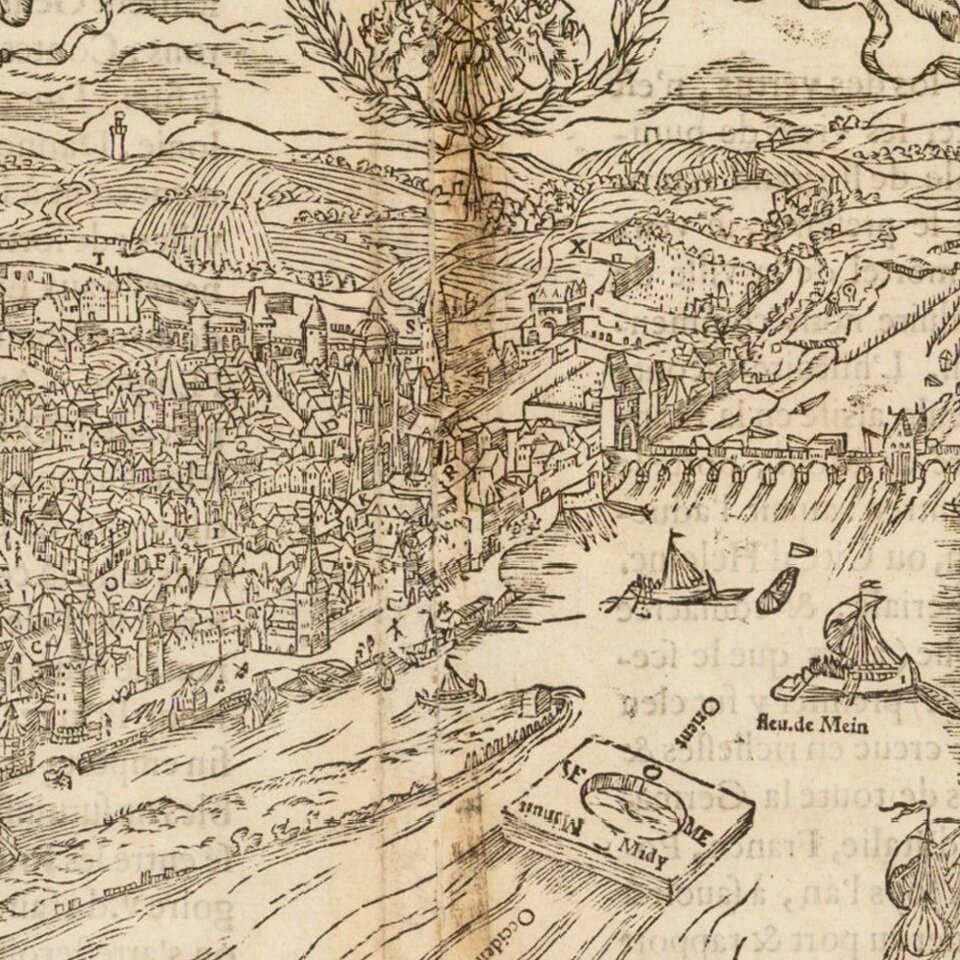
This engaging view depicts Frankfurt, one of Europe's most vibrant cities, along the Main River. The scene assumes an eastward perspective, with the principal part of the city lying on the left-hand side, enveloped by old walls. Frankfort had the largest medieval city center in all of Germany and is shown to be dominated by the spires of numerous churches. A great bridge connects the two parts of the city, over the river bustling with commercial traffic, while the Taunus Mountains occupy the background. A key along the lower part of the view labels numerous important buildings. At the top of the view are the double-headed eagle arms of the Holy Roman Emperor, then the Habsburg ruler, Charles V. The view is embellished by elegant Mannerist-style borders.
In 1372, Frankfurt became a Reichsstadt (Imperial Free City), meaning that it was subject only to the authority of the Holy Roman Emperor and was not under the control of any local rulers or nobles. This status allowed the city-state to avoid involvement in many wars and to act as a safe haven for many commercial and intellectual activities.
Frankfurt had long been one of the most important cities in the Holy Roman Empire. Since 855, German emperors were elected in Frankfurt, before being crowned in Aachen. However, only 9 years after this print was made, in 1562, the city played host to the coronation of Maximilian II. From that point onwards, all Holy Roman Emperors were crowned in the city until 1792. These ceremonies all took place in St. Bartholomäus Cathedral, known as the 'Kaiserdom' (Emperor's Cathedral), noted as 'A' on the map's key.
The Frankfurter Messe (the Annual Frankfurt Trade Fair), is thought to have been first held around 1150. In 1240, Emperor Friedrich II granted an Imperial privilege to its visitors, meaning they would be protected by official warrant. By the late 14th Century the fair became the largest in Europe. The accompanying Frankfort Book Fair was first held in 1478 and remains to this day the most important annual event in the publishing world.
In 1585, Frankfurt traders established a system of exchange rates for the various currencies, thus setting the basis for the Frankfurt Stock Exchange. The Frankfurt exchange is today second in Europe only to London's exchange.
The present view is from Guillaume Guéroult's Épitomé de la corographie d'Europe illustré des pourtraitz des villes plus renommées d'icelle, mis en françoys… (Lyon: Balthazar Arnoullet, 1553), a fine early book featuring many views of European cities. Guéroult's view of Frankfurt is derived from Sebastian Münster's Cosmographiae Universalis, first published in Basle in 1544.
Guillaume Guéroult (1507-1569) was an important French publisher, editor, translator and poet. While born in Rouen, he spent most of his career in Lyon. In addition to the Épitomé, highlights of his work include a book on the French-Habsburg Wars, Apologie pour le Roy, contre les calomnies des imperiaulx (1551); an illustrated history of the Holy Roman Emperors, Des Chroniques & gestes admirables des empereurs: auec les effigies d'iceux (1552), a finely illustrated work illustrating biblical stories, Le Premier Livre des emblesmes (1550) and a work on botany, L'Histoire des plantes mis en commentaires (1550).
If you are a student, write to us in telegram: @antiquemaps and indicate what material you need and for what work you need a map in high detail. We are ready to provide material on special terms. For students only!