Map size in jpg-format: 24.3312MiB
Click to open in high resolution (open in new tab).
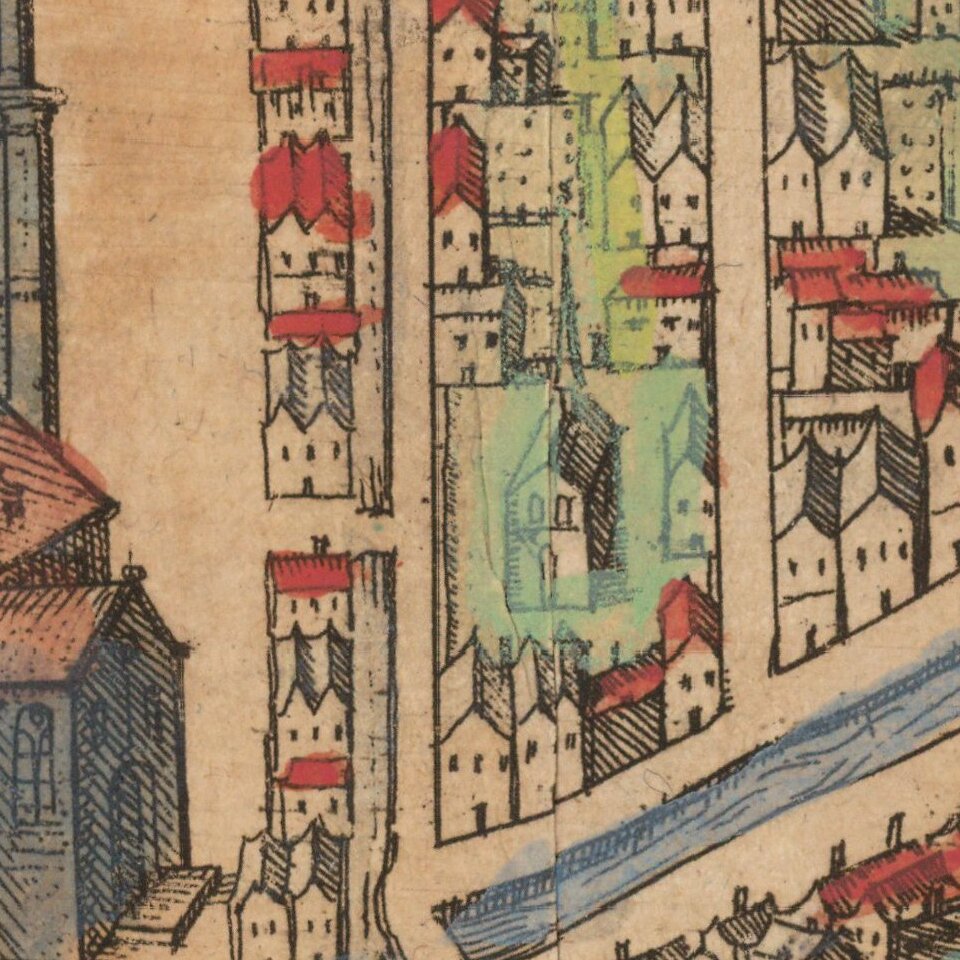
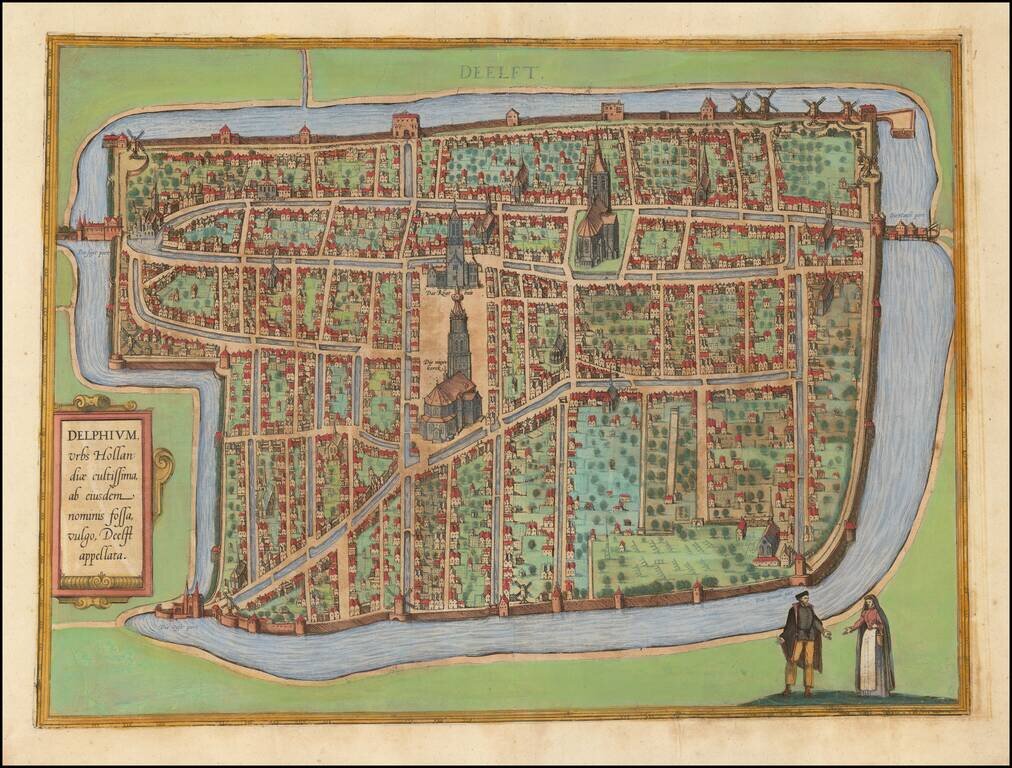
Nice old color example of the first state of Braun & Hogenberg's view of Delft.
The first state includes a simple lettered title cartouche and an the name "Deelft" at the top. The later state adds a more elaborate script in both the title and the top lettering.
The translation of the title is: Delphum, a highly cultivated city in Holland, named after the canal of the same name, in Dutch Delft.
Text on the verso transalates as follows (Taschen):
Delft is surrounded by thick ring walls and with such a wide moat that even a strong man can barely throw a stone across it. The buildings within are magnificently constructed. If we start with the churches, first mention must go to the main church, called the New Church, a large, magnificent and beautiful church dedicated to St Ursula. There is also a large market in the city.
The city, criss-crossed by numerous narrow canals, is seen in a bird's-eye from the east. Its main buildings, on other hand, are presented in an impressive fashion in side view: the New Church (Nieuwe Kerck) on the market square with its enormous tower and the Gothic town hall (Das Rath huis). Granted its charter in 1246, Delft became an important centre of trade for the region. In 1618 the town hall burned to the ground and - with the exception of its prison tower Het Steen - thus no longer survives in the form illustrated here. Not far from the central market square rises the Oude Kerk, whose leaning tower, known as the "Lange Jan", has become Delft's landmark. Behind the Oude Kerk lies the convent of Sint-Agatha, today known as the Prinsenhof (Prince's Court), since William I, Prince of Orange, resided here.
Georg Braun (1541-1622) was born and died in Cologne. His primary vocation was as Catholic cleric; he spent thirty-seven years as canon and dean at the church St. Maria ad Gradus, in Cologne. Braun was the chief editor of the Civitates orbis terrarum, the greatest book of town views ever published. His job entailed hiring artists, acquiring source material for the maps and views, and writing the text. In this role, he was assisted by Abraham Ortelius. Braun lived into his 80s, and he was the only member of the original team to witness the publication of the sixth volume in 1617.
If you are a student, write to us in telegram: @antiquemaps and indicate what material you need and for what work you need a map in high detail. We are ready to provide material on special terms. For students only!