Map size in jpg-format: 30.1522MiB
Click to open in high resolution (open in new tab).
An Intriguing Bird's Eye View of Our Galaxy
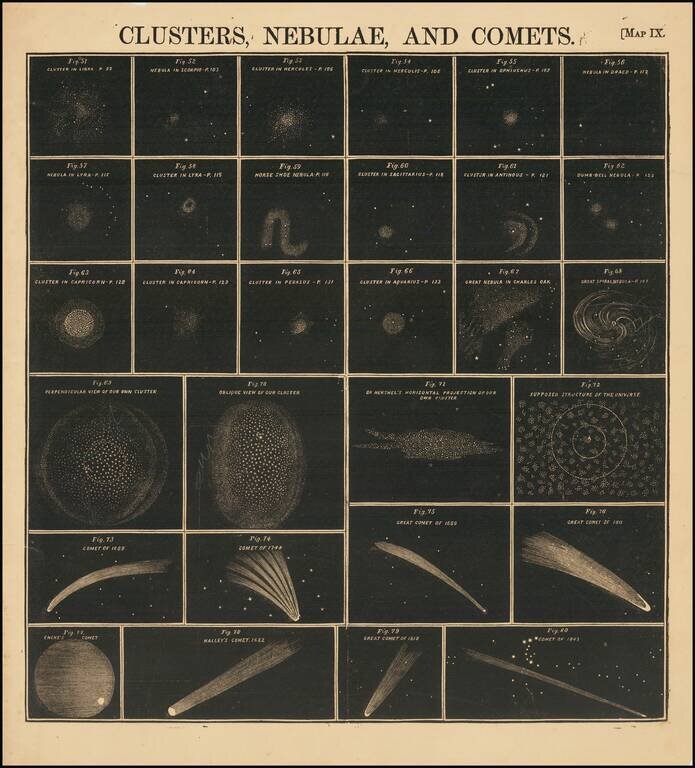
This is a fabulous chart of various faint objects visible in the night sky, showing both deep-space clouds of gas as well as near-earth comets. The individual images are well designed, showing the objects in question as well as surrounding stars. For many of the clusters and nebulae, Burritt portrays individual stars rather than a blend of light, which is what is actually visible from earth.
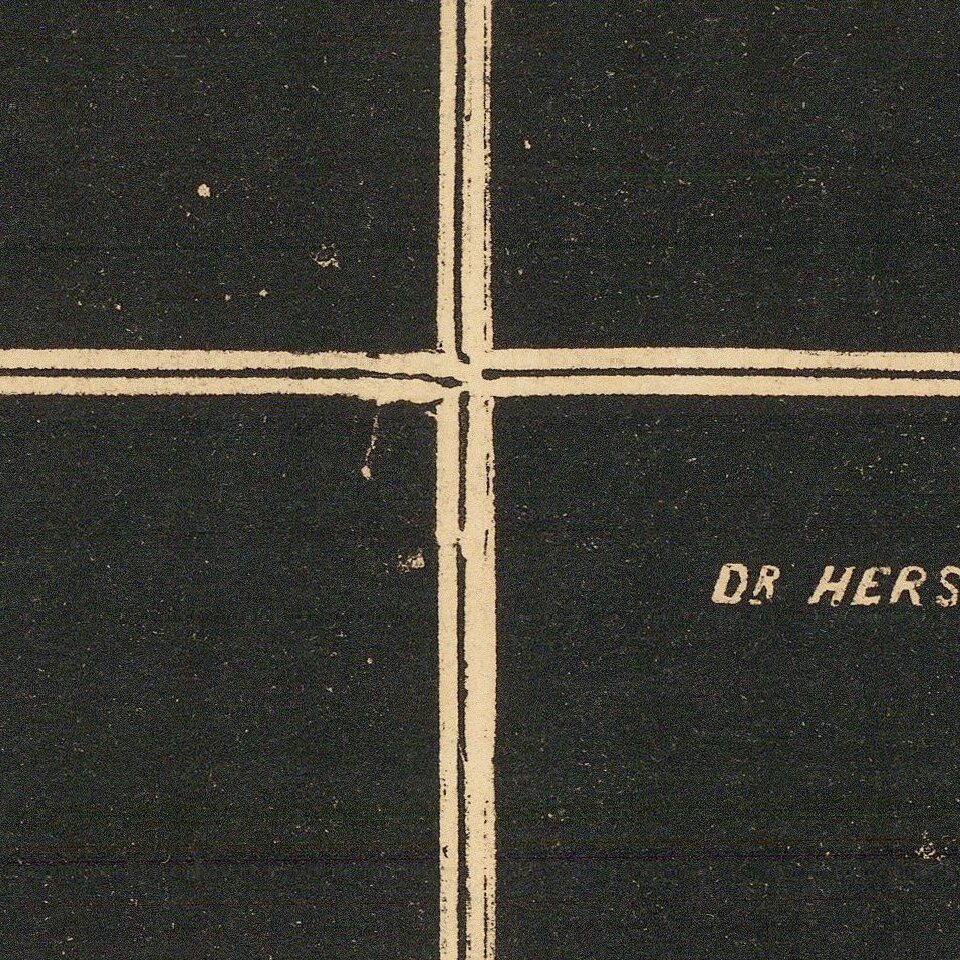
Many well-known objects are here portrayed. This includes the Herculean Star Cluster, Horseshoe Nebula, Aquarius Star Cluster, Great Spiral Nebula, 1869 Comet, and Haley's Comet. Four images are particularly interesting. These are what Burritt be perpendicular and oblique views of our own cluster, "Dr. Hershel's" opinion of what a horizontal projection of our cluster looks like, and a "supposed structure of the universe." These follow in the tradition of William Herschel's heliocentrism, which purported that the sun was at the center of our galaxy. Despite this misconception, Herschel's observations helped to start the field of observational cosmology. This field seeks to understand the universe as a whole, a tradition here portrayed and center to many fields of modern astronomy. The "supposed structure of the universe" appears to follow a more Kantian view of astronomy.
This work was published as Map IX in Atlas Designed to Illustrate Burritt's Geography of the Heavens, an accompaniment to another of Burritt's works as the title would suggest. The author, Burritt, grew up poor in Massachusetts and had to abandon his education at Williams College due to a lack of funds. He moved to Georgia, where he worked as an editor and started a family, but had to flee after he was accused of being anti-slavery. Upon his return to the north, Burritt would build himself an observatory. This would lead to his Geography of the Heavens, a very influential early 19th-century astronomical text. The atlas was well-illustrated and received. Burritt would die at forty-four while sailing to the newly independent Republic of Texas.
If you are a student, write to us in telegram: @antiquemaps and indicate what material you need and for what work you need a map in high detail. We are ready to provide material on special terms. For students only!