Map size in jpg-format: 25.0062MiB
Click to open in high resolution (open in new tab).
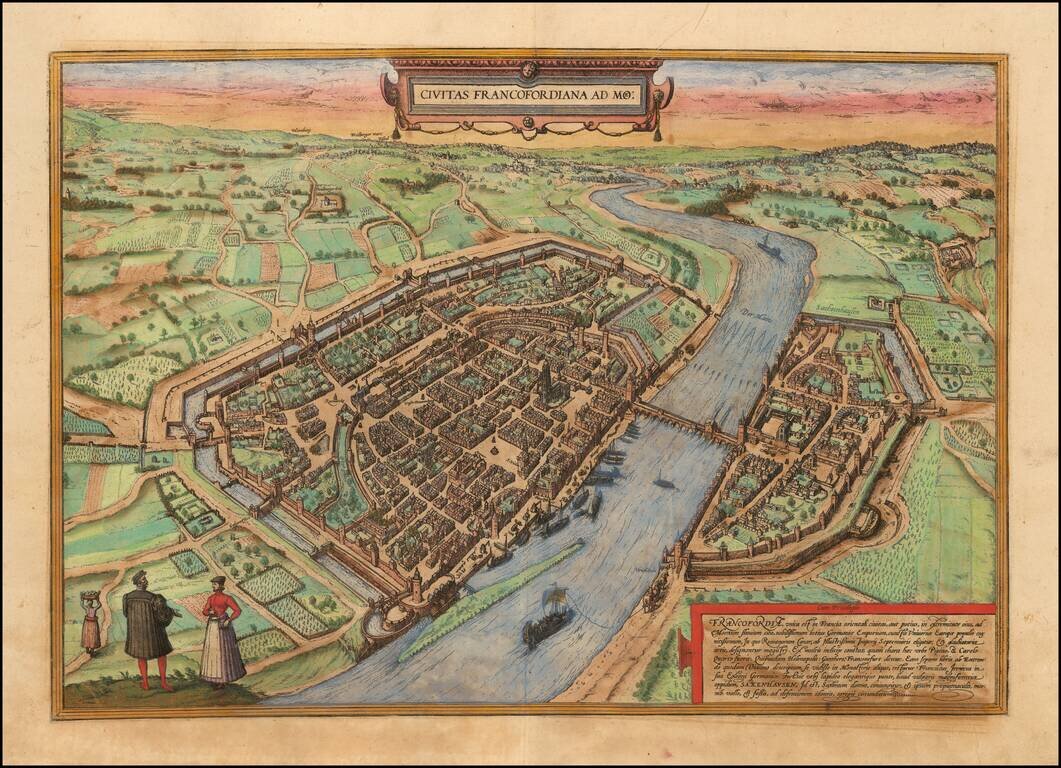
Important early view of Frankfurt am Rhein, from Braun & Hogenberg's Civitatus Orbis Terrarum, the most important book of town plans and views published in the 16th Century.
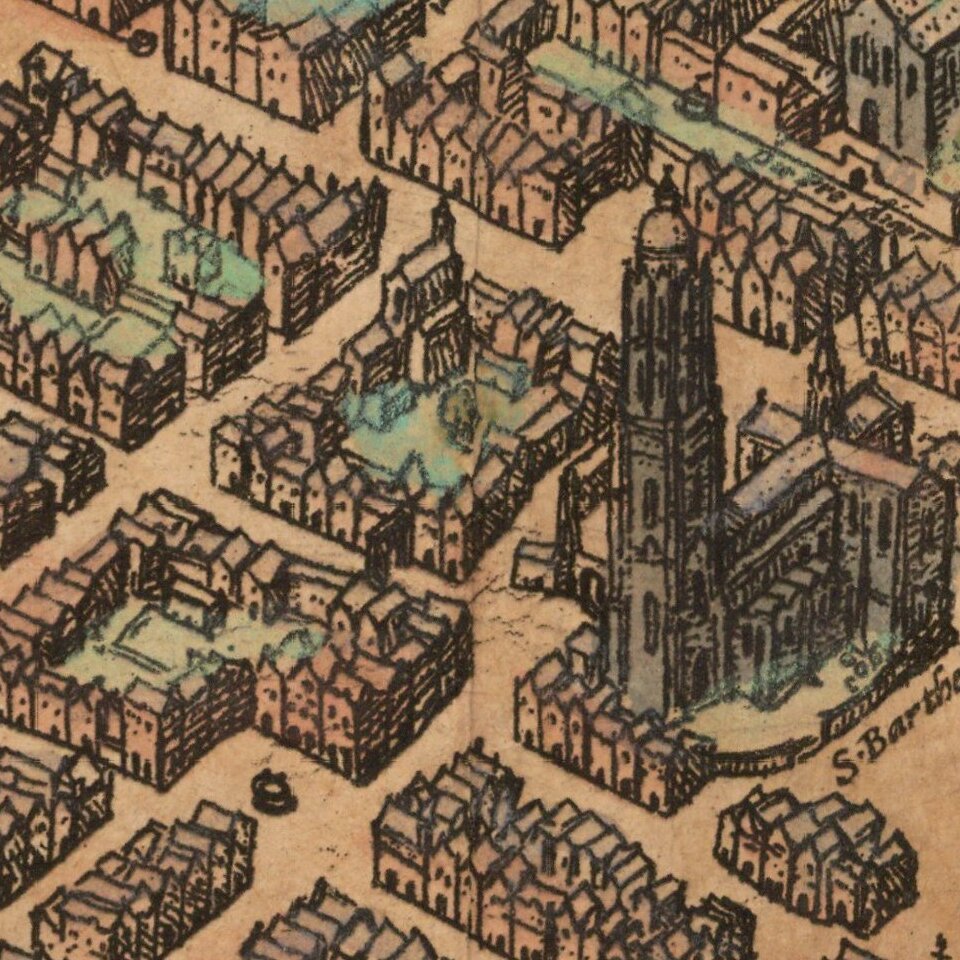
Fine early bird's-eye view from the southwest. St Bartholomew's cathedral, coronation church of the German kings and emperors, stands on the hill at the core of the original settlement on the right bank of the Main. On the Römerberg hill further left, the Römer and Goldener Schwan houses served as the town hall from 1405 onwards; to their right lies the Gothic councillors' church of St Nicholas. Identified in the Sachsenhausen quarter are the church of the Magi (H. Drei Konig), which became Frankfurt's first Protestant church in 1525, and the house of the Teutonic Knights (Teutsch Hauss). Frankfurt had been established as an international trade-fair center and city of commerce in the Middle Ages. Its autumn fair had been running since the 12th century and the spring fair since 1330. By around 1600 the book fair in this publishing city had already assumed international proportions.
The cartouche translates as follows:
Frankfurt is a unique city in East Franconia, or rather, at its extremity, lying on the Main, the most famous trade city in all Germany, very well known amongst all the peoples of Europe; the Roman Emperor is elected here by the most illustrious College of Seven, the Electors, and the fencing masters designated. [...] In his treatise on Germany, Franciscus Irenicus attests that he has seen in a monastery a description of Frankfurt in seven books, written by a deacon named Entrandus. Connected to Frankfurt by an elegant stone bridge is Sachsenhausen, a town of no ordinary magnificence. Frankfurt is surrounded by bulwarks, walls, ramparts and moats that are exceptionally well designed for defensive purposes.The text on the verso translates as follows:
The largest and most magnificent part of the city is called Frankfurt, the other Sachsenhausen, which is also surrounded by walls and moats. Frankfurt is a leading center of trade not just in Germany but in Europe. For twice a year, before Easter, in the middle of Lent, and in autumn, large numbers of merchants come from Lower and Upper Germany and from many other parts of the world to the annual fairs here. Emperor Charles IV also had a particular liking for this city, and therefore he moved the election of the kings and emperors of the Romans to here and confirmed this in his Golden Bull.Georg Braun (1541-1622) was born and died in Cologne. His primary vocation was as Catholic cleric; he spent thirty-seven years as canon and dean at the church St. Maria ad Gradus, in Cologne. Braun was the chief editor of the Civitates orbis terrarum, the greatest book of town views ever published. His job entailed hiring artists, acquiring source material for the maps and views, and writing the text. In this role, he was assisted by Abraham Ortelius. Braun lived into his 80s, and he was the only member of the original team to witness the publication of the sixth volume in 1617.
If you are a student, write to us in telegram: @antiquemaps and indicate what material you need and for what work you need a map in high detail. We are ready to provide material on special terms. For students only!