Map size in jpg-format: 64.0516MiB
Click to open in high resolution (open in new tab).
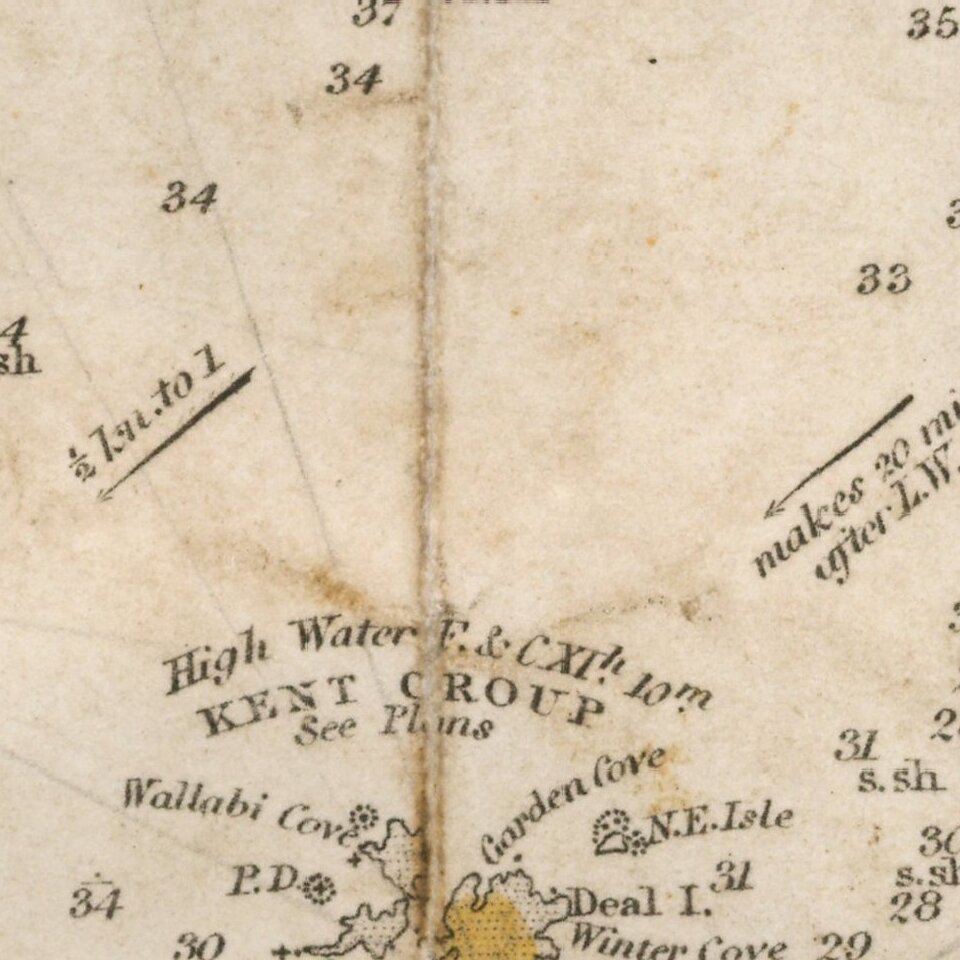
With Hand Drawn Annotations Showing Contemporary Use At Sea
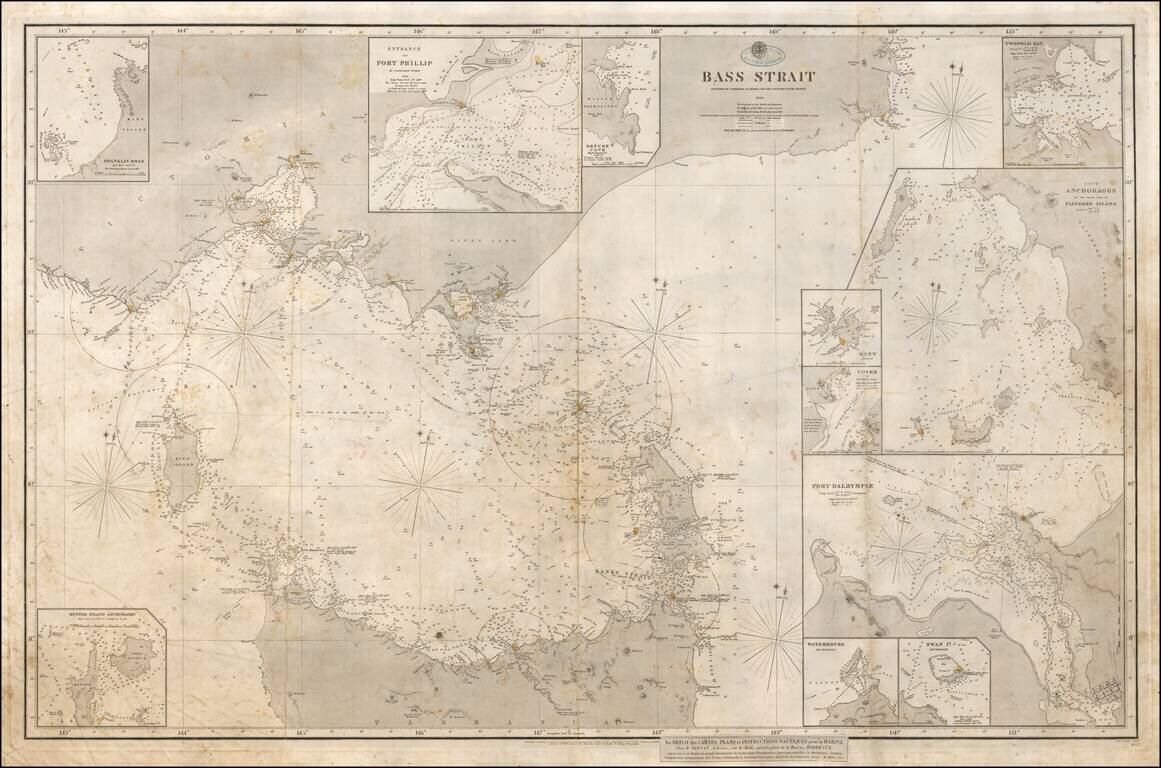
Annotated example of the 1843 edition of the British Admiralty Chart of the strait between Melbourne and Tasmania, revised and improved to 1844 and 1858.
The map is based upon the explorations and surveys of Commander John Lort Stokes and the officers of the H.M.S. Beagle 1843. The chart shows both the fine details of Stokes work (and prior explorations), along with the vast swaths of coastline still unexplored on the western and eastern sections of the chart.
The chart includes insets of the Entrance to Port Philip, Refuge Cove, Franklin Road, Hunter Island, Waterhouse, Swan Island, Port Dalrymple, the west side of Flinders's Island, the Kent Islands, Coves in Murray's Pass and Twofold Bay.
John Lort Stokes (1811-1885) joined the British Navy in 1824. He joined the crew of the H.M.S. Beagle, where he served under various commanders, including the period from 1831 to 1836, when Charles Darwin undertook his voyages.
In 1837, Stokes was commissioned by the British Hydrographic Office to chart unknown parts of the Australian coastline aboard the Beagle and later became the ship's commander in 1841. Through his travels, Stokes circumnavigated Australia twice, discovered the Fitzroy, Albert, and Flinders rivers, and charted the legendary graveyard of sailing ships known as Bass Strait. During the survey of the Timor Sea in 1839, Stokes undertook the closer examination of what is now the Northern Territory coast. He was the first to discover and name the Victoria River and Port Darwin (named for Charles Darwin). Upon his return to England, he authored Discoveries in Australia, with an account of the coasts and rivers explored and surveyed during the voyage of the Beagle, 1837-1843 which was published in 1846.
French bookseller's label: "Au Depot des Cartes, Plans et Instructions Nautiques pour la Marine Chez P. Sauvat, Libraire..."
The British Admiralty has produced nautical charts since 1795 under the auspices of the United Kingdom Hydrographic Office (HO). Its main task was to provide the Royal Navy with navigational products and service, but since 1821 it has also sold charts to the public.
In 1795, King George III appointed Alexander Dalrymple, a pedantic geographer, to consolidate, catalogue, and improve the Royal Navy’s charts. He produced the first chart as the Hydrographer to the Admiralty in 1802. Dalrymple, known for his sticky personality, served until his death in 1808, when he was succeeded by Captain Thomas Hurd. The HO has been run by naval officers ever since.
Hurd professionalized the office and increased its efficiency. He was succeeded by the Arctic explorer Captain William Parry in 1823. By 1825, the HO was offering over seven hundred charts and views for sale. Under Parry, the HO also began to participate in exploratory expeditions. The first was a joint French-Spanish-British trip to the South Atlantic, a voyage organized in part by the Royal Society of London.
In 1829, Rear-Admiral Sir Francis Beaufort was appointed Hydrographer Royal. Under his management, the HO introduced the wind force scale named for him, as well as began issuing official tide tables (1833). It was under Beaufort that HMS Beagle completed several surveying missions, including its most famous voyage commanded by Captain FitzRoy with Charles Darwin onboard. When Beaufort retired in 1855, the HO had nearly two thousand charts in its catalog.
Later in the nineteenth century, the HO supported the Challenger expedition, which is credited with helping to found the discipline of oceanography. The HO participated in the International Meridian Conference which decided on the Greenwich Meridian as the Prime Meridian. Regulation and standardization of oceanic and navigational measures continued into the twentieth century, with the HO participating at the first International Hydrographic Organization meeting in 1921.
During World War II, the HO chart making facility moved to Taunton, the first purpose-built building it ever inhabited. In 1953, the first purpose-built survey ship went to sea, the HMS Vidal. Today, there is an entire class of survey vessels that make up the Royal Navy’s Hydrographic Squadron. The HO began to computerize their charts in the late 1960s and early 1970s. In 1968, the compilation staff also came to Taunton, and the HO continues to work from there today.
If you are a student, write to us in telegram: @antiquemaps and indicate what material you need and for what work you need a map in high detail. We are ready to provide material on special terms. For students only!

![[English Edition!] Maris Pacifici quod vulgo Mar del Zud](/map/small/71000.jpg)