Map size in jpg-format: 82.7239MiB
Click to open in high resolution (open in new tab).
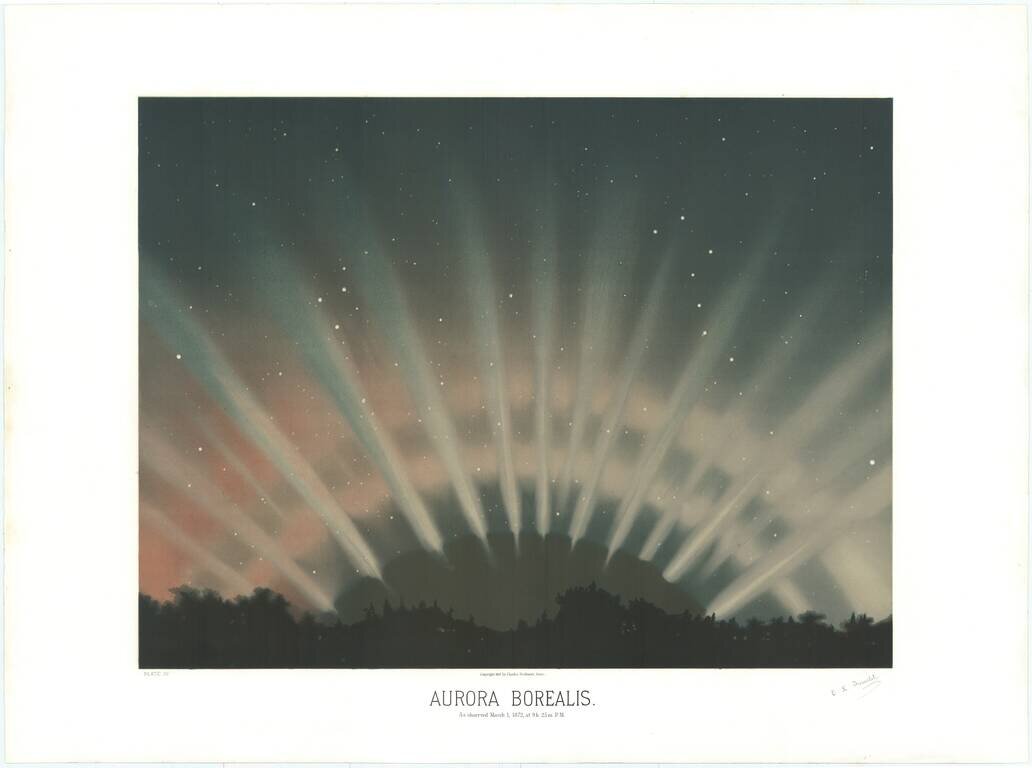
An Excellent and Breathtaking Lithograph of an Aurora. Made by the "Audubon of the Sky", Etienne Trouvelot.
This is a beautiful color lithograph of an aurora borealis, by Etienne Trouvelot, relating his observations made at the end of winter in 1872. The chromolithograph was published as part of Trouvelot's Astronomical Drawings set of 15 plates by Charles Scribner's Sons in 1882.
Trouvelot's drawings are known as some of the best images of the sky ever made. Trouvelot's work was very important at the time, as it provided important images of the stars, planets, and phenomena of the sky at a time when popular interest in astronomy was growing, but photography had not yet become advanced enough to capture such dark images. Trouvelot's images are recognized as the last of the great images of the night sky that surpassed the photography of their day. This is especially true for his presented capture of an aurora, for which cameras would take decades to catch up with.
A Winter of Southerly Auroras
The Carrington Event of 1859 was the strongest aurora to have been recorded, with clear sightings in the Caribbean and reports from Colombia. It was also one of the first times that the electric properties of auroras had been measured, both through scientific observations as well as the experiences of telegraph operators. These long lines of conductive material experienced geomagnetic forcing from the event. While most lines became inoperable during the storm, some lines were of the correct length that a geomagnetically induced current occurred, and telegraph operators were able to switch off their current sources for several hours. The economic cost of a similar event today to the global economy would be trillions of US dollars.
The public would have to wait thirteen years before another aurora event strong enough to affect telegraph lines would occur. In January, February, and March of 1872, auroras occurred with unusual frequency, peaking in the first few days of February. Better prepared this time, scientists were able to make observations on the phenomena.
It had been auroras that had first interested Trouvelot in astronomy, and by 1872 he had been invited to work at Harvard. Trouvelot's present work comes at the waning of this period of great auroras, though it is unknown how many other sketches he made during this cycle.
Trouvelot describes the work as follows in his Trouvelot Astronomical Drawings Manual:
The view presents the rare spectacle of an aurora spanning the sky from east to west in concentric arches. The Polar Star is nearly central in the back-ground, the constellation of the Great Bear on the right and Cassiopeia’s chair on the left. The large star at some distance above the horizon on the right is Arcturus. The almost black inner segment of the aurora resting upon the horizon, has its summit in the magnetic meridian, which was in this case a little west of north, its arc being indented by the bases of the ascending streamers. Both streamers and arches were, when observed, tremulous with upward pulsations and there was also a wave-like movement of the streamers from west to east. The prevailing color of this aurora is a pale whitish green and the complementary red appears especially at the west end of the auroral arch. The summits of the streamers are from four hundred to live hundred miles above the earth and the aurora is therefore a phenomenon of the terrestrial atmosphere rather than of astronomical observation proper.
It would be many years before photography could catch up to lithographs when capturing auroras. Photography of auroras was, and still remains to the amateur, very difficult so this image would remain the gold standard of aurora representations for many years.
Rarity
Trouvelot's prints were originally intended for the astronomical and scientific community and most of the larger US observatories purchased copies of the portfolio. In 2002, B.G. Corbin undertook a census to determine the number of surviving copies of the complete set of 15 prints and was only able to confirm the existence of 4 complete sets.
If you are a student, write to us in telegram: @antiquemaps and indicate what material you need and for what work you need a map in high detail. We are ready to provide material on special terms. For students only!